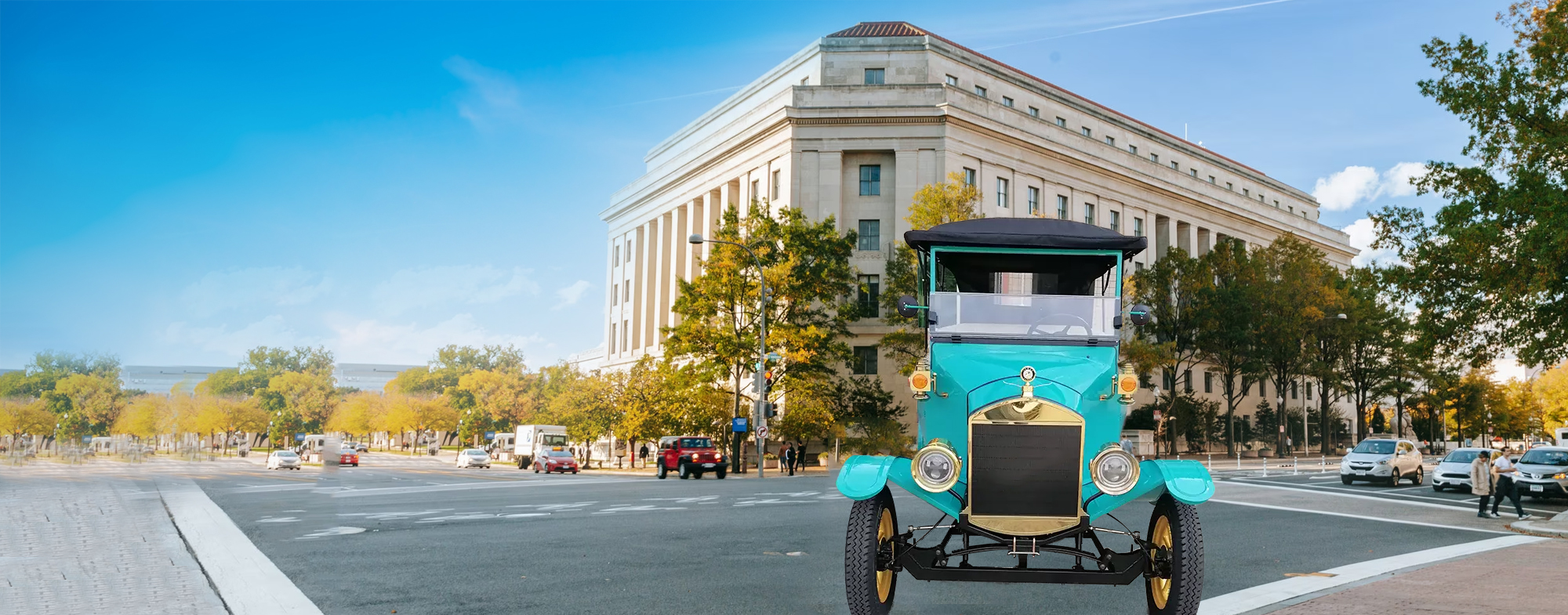
Four beautiful outdoor spaces illustrate the life and leadership of a president who guided the nation through the Great Depression and World War II. Walk through four open-air rooms, feeling the hope and resilience that defined his four terms. Our DC's best tour guides make history come alive.
The Franklin Delano Roosevelt Memorial is one of the most distinctive memorials in Washington DC. Located along the Tidal Basin between the Lincoln Memorial and Jefferson Memorial, it tells the story of Franklin Delano Roosevelt's presidency through bronze sculptures, waterfalls, granite walls, and inscriptions.
Dedicated in 1997, the memorial honors Franklin D. Roosevelt, the 32nd President of the United States, who led the country through the Great Depression and World War II. Instead of a single monument, the memorial uses a sequence of outdoor spaces to take visitors through the four terms of his presidency.
Explore the private Washington DC tour with DC Monuments Tour to see the Franklin Delano Roosevelt Memorial alongside other major monuments and memorials with a local guide.
About the Franklin Delano Roosevelt Memorial
The Franklin Delano Roosevelt Memorial is a 7.5-acre outdoor memorial located on the southwest side of the Tidal Basin. Its landscape design is different from the traditional marble structures found elsewhere around the National Mall.
Landscape architect Lawrence Halprin designed the memorial as a chronological journey through Roosevelt's presidency. Five outdoor spaces make up the memorial: a prologue room followed by four rooms representing each of Roosevelt's four terms in office.
Water, stone, trees, sculptures, and engraved quotations work together to create a memorial that feels more like a walk through history than a single monument.
The memorial's design reflects major events and themes from Roosevelt's presidency, including the Great Depression, the New Deal, World War II, leadership, hardship, and hope.
Franklin Delano Roosevelt Memorial Quick Facts
- Dedicated to: Franklin Delano Roosevelt, the 32nd President of the United States
- Dedicated: May 2, 1997
- Prologue dedicated: January 10, 2001
- Designer and landscape architect: Lawrence Halprin
- Location: West Potomac Park along the Tidal Basin
- Size: Approximately 7.5 acres
- Layout: One prologue and four rooms representing Roosevelt's four presidential terms
- Materials: South Dakota granite, bronze sculptures, water, and landscaping
- Entrance fee: Free
- Hours: Open 24 hours a day
- Accessibility: The memorial is wheelchair accessible
Why Is the Franklin Delano Roosevelt Memorial Important?
Franklin D. Roosevelt served as president from 1933 until his death in 1945. His presidency covered two of the most challenging periods in modern American history: the Great Depression and World War II.
The memorial presents this history through physical spaces rather than relying only on traditional plaques. Visitors move through different rooms, each reflecting a different stage of Roosevelt's presidency.
The result is an experience that connects political history with the lives of ordinary Americans affected by economic hardship, unemployment, social programs, and war.
Roosevelt's own words are also an important part of the memorial. Quotations are carved into the granite walls, allowing visitors to encounter his ideas while moving through the memorial.
Franklin Delano Roosevelt Memorial Design & Architecture
The FDR Memorial was designed by landscape architect Lawrence Halprin, who approached the memorial as a sequence of outdoor spaces rather than a conventional monument.
The use of red South Dakota granite creates large walls and pathways throughout the site. Water features appear throughout the memorial, while bronze sculptures bring important moments from Roosevelt's presidency into the visitor experience.
The memorial contains more than 31,000 granite stones, with the largest single stone weighing approximately 4.5 tons. More than 100,000 gallons of water flow through its seven fountains and pools.
Instead of viewing the memorial from one central point, visitors move through it in chronological order. That progression is an important part of understanding the story the designers intended to tell.
Explore the Four Terms of Franklin D. Roosevelt's Presidency
Prologue - FDR and His Disability
The memorial begins with a prologue featuring a life-size bronze sculpture of Franklin Roosevelt sitting in a wheelchair.
Roosevelt was diagnosed with polio at age 39 and experienced paralysis in his legs. During his presidency, his disability was often carefully concealed from the public.
The wheelchair sculpture was added in 2001 and provides an important part of the memorial's story. It acknowledges Roosevelt's disability while also emphasizing his perseverance and leadership.
This area also introduces visitors to Roosevelt before they continue into the four presidential-term rooms.
First Term - The Great Depression and the New Deal
The first-term room focuses on the Great Depression and the New Deal programs introduced during Roosevelt's presidency.
Bronze sculptures portray people affected by the economic crisis, including the famous Breadline sculpture. Another sculpture depicts people listening to a fireside chat, reflecting the way Roosevelt used radio communication to speak directly with Americans.
The room presents both the hardship of the Depression and the sense of hope associated with Roosevelt's response.
Second Term - Economic Recovery and Social Programs
The second-term section continues the story of Roosevelt's administration and its New Deal programs.
Bronze bas-relief panels and other sculptural elements represent people and projects connected with the New Deal. The artwork illustrates the scale of government programs created during a period of severe economic difficulty.
Water features and granite walls continue the memorial's landscape storytelling approach, encouraging visitors to slow down and examine the artwork rather than simply passing through.
Third Term - World War II
The third-term room focuses on World War II and uses a dramatically different visual atmosphere.
A large waterfall crashes over scattered blocks of stone, creating a sense of movement and disruption. The design represents the destruction and chaos associated with the war.
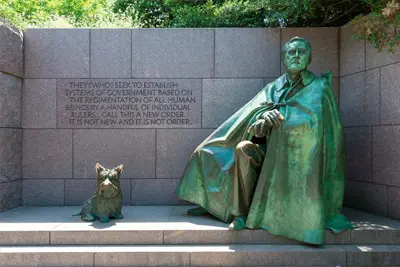
A larger-than-life sculpture of Franklin Roosevelt sits beside his Scottish terrier, Fala. The sculpture gives visitors a quieter moment within an otherwise dramatic section of the memorial.
The room also contains quotations from Roosevelt addressing the challenges of war and the struggle against tyranny.
Fourth Term - Loss, Peace and Eleanor Roosevelt
The fourth-term room reflects the final period of Roosevelt's presidency and his death in April 1945.
A low-relief sculpture depicts Roosevelt's funeral procession along Pennsylvania Avenue. A quieter pool of water creates a reflective setting around the artwork.
The room also features a sculpture of Eleanor Roosevelt, recognizing her public service and her role in international affairs. An emblem of the United Nations appears behind her statue.
Together, these elements shift the focus from wartime leadership toward mourning, international cooperation, and the future.
FDR Memorial Sculptures You Should See
One of the best reasons to visit the Franklin Delano Roosevelt Memorial is the range of sculptures incorporated into the landscape.
FDR in a Wheelchair
The life-size wheelchair sculpture in the prologue provides a direct representation of Roosevelt's disability and is one of the memorial's most important additions.
The Breadline
George Segal's The Breadline represents the hardship experienced by Americans during the Great Depression. The human figures make the economic crisis feel personal rather than simply historical.
Fireside Chat
The memorial also depicts people gathered around a radio during a fireside chat. The sculpture represents Roosevelt's direct communication with the American public during difficult times.
FDR and Fala
The larger-than-life bronze sculpture of Roosevelt with Fala appears in the World War II section. Fala, Roosevelt's Scottish terrier, became one of the president's best-known companions.
Eleanor Roosevelt
The fourth-term room contains a sculpture of Eleanor Roosevelt. Her presence recognizes her contributions as First Lady and her later work representing the United States at the United Nations.
Waterfalls, Pools & the Meaning of Water
Water is one of the defining features of the Franklin Delano Roosevelt Memorial.
Instead of using water simply as decoration, the memorial incorporates fountains, waterfalls, and pools into the storytelling experience. The changing movement of water helps distinguish different sections of the memorial.
The third-term waterfall, for example, is especially dramatic. Its crashing water and scattered stone blocks create a visual representation of the destruction associated with World War II.
Other areas use calmer pools and quieter water features to create spaces for reflection.
Franklin Delano Roosevelt Memorial Quotes
Roosevelt's words are an important part of the memorial. Twenty-two quotations from his presidency are engraved into the red South Dakota granite walls.
These inscriptions cover subjects including economic hardship, leadership, democracy, war, peace, and the future.
One of the best-known quotations associated with Roosevelt's presidency is his 1933 statement, "The only thing we have to fear is fear itself."
Rather than placing the quotations in a separate exhibit, the memorial integrates them into the walls and pathways. Visitors encounter Roosevelt's words while moving through the chronological story of his presidency.
Where Is the Franklin Delano Roosevelt Memorial?
The Franklin Delano Roosevelt Memorial is located along the western shore of the Tidal Basin in Washington DC.
Address: 400 West Basin Drive SW, Washington, DC 20002
The memorial sits between the Lincoln Memorial and Jefferson Memorial, making it convenient to include several major Washington DC landmarks in the same sightseeing route.
Its location also places it close to the Martin Luther King Jr. Memorial and other important National Mall attractions.
Franklin Delano Roosevelt Memorial Hours & Admission
The Franklin Delano Roosevelt Memorial is an outdoor memorial and is open 24 hours a day.
There is no entrance fee or pass required to visit the memorial.
Because the memorial is outdoors, visitors should prepare for changing weather conditions. Granite surfaces can become slippery when wet, so take care when walking after rain.
The fountains typically operate during the spring, summer, and fall months.
Is the Franklin Delano Roosevelt Memorial Accessible?
Yes. The Franklin Delano Roosevelt Memorial is wheelchair accessible, with accessible pathways throughout the site.
The National Park Service provides wide paths with firm granite pavers, along with ramps and stairs in different areas. There are also numerous benches and resting areas throughout the memorial.
Accessible restrooms are available, and the National Park Service provides additional accessibility information for visitors with mobility, vision, hearing, or other accessibility needs.
If accessibility is important to your Washington DC sightseeing plans, our Washington DC accessibility guide provides additional information about visiting National Mall attractions.
Best Time to Visit the Franklin Delano Roosevelt Memorial
Because the memorial is open around the clock, you can visit at almost any time of day.
Early Morning
Early morning can provide a quieter atmosphere and softer natural light. It can be a good choice if you want more time to read the inscriptions and examine the sculptures without heavy crowds.
Afternoon
Afternoon visits work well when the FDR Memorial is part of a larger National Mall sightseeing route. You can combine it with nearby memorials around the Tidal Basin before continuing toward the Lincoln Memorial or Washington Monument.
Sunset
Late afternoon and sunset can provide beautiful light across the granite walls, sculptures, and water features.
Night
The memorial is open 24 hours and is illuminated after dark. A nighttime visit can create a quieter atmosphere and a different visual experience from daytime sightseeing.
For more ideas, see our guide to Washington DC night tours and the best places to visit after dark.
How Long Does It Take to Visit the FDR Memorial?
The National Park Service estimates a visit can take approximately 15 to 60 minutes depending on how you explore the site.
If you simply want to see the major sculptures and waterfalls, you can move through the memorial relatively quickly. However, visitors interested in Roosevelt's history, quotations, and artwork should allow more time.
For a first visit, around 30 to 60 minutes is a comfortable amount of time to walk through the rooms, stop for photographs, and read some of the inscriptions.
Nearby Attractions to Combine With the FDR Memorial
The FDR Memorial is especially convenient for visitors who want to see several Washington DC monuments in one sightseeing trip.
Martin Luther King Jr. Memorial
The Martin Luther King Jr. Memorial is located nearby along the Tidal Basin. You can learn more about this important landmark in our Martin Luther King Jr. Memorial tour guide.
Jefferson Memorial
The Jefferson Memorial is also located along the Tidal Basin. Its neoclassical architecture provides a strong contrast to the landscape-based design of the FDR Memorial.
Lincoln Memorial
The Lincoln Memorial sits west of the FDR Memorial and is one of the most recognizable landmarks on the National Mall.
Our Lincoln Memorial tour guide covers its history, architecture, and significance.
Washington Monument
The Washington Monument is another major landmark that can be included in a National Mall sightseeing route. Its location makes it easy to combine with several nearby memorials.
World War II Memorial
The World War II Memorial sits between the Washington Monument and Lincoln Memorial and is another meaningful stop for visitors interested in American history.
For a broader overview of the city's major landmarks, see our guide to the best Washington DC monuments to visit in 2026.
Explore the FDR Memorial With DC Monuments Tour
The Franklin Delano Roosevelt Memorial is easier to appreciate when you understand the story behind its sculptures, water features, inscriptions, and four presidential-term rooms.
DC Monuments Tour includes the FDR Memorial among the major Washington DC landmarks featured in its sightseeing experiences. A local guide can help put the memorial into context while you explore the wider National Mall.
Our Washington DC Day Tour is a convenient option for visitors who want to see several major landmarks during the day.
For visitors who prefer a more personalized experience, our Private Washington DC Tours provide a more flexible way to explore the city's monuments and memorials.
You can also explore the FDR Memorial after dark as part of our Washington DC Night Tour.
Why Visit the Franklin Delano Roosevelt Memorial?
The FDR Memorial is worth visiting because it tells history differently from many other Washington DC monuments.
- Experience a chronological story: Walk through a prologue and four rooms representing Roosevelt's presidency.
- See powerful sculptures: Explore works depicting the Great Depression, New Deal, World War II, Roosevelt, Fala, and Eleanor Roosevelt.
- Read Roosevelt's own words: More than 20 quotations are incorporated into the memorial's granite walls.
- Experience the waterfalls: Water is an important part of the memorial's landscape and symbolism.
- Explore an accessible memorial: The National Park Service provides accessible pathways and facilities.
- Combine it with nearby landmarks: The memorial is conveniently located near the Jefferson, Martin Luther King Jr., and Lincoln memorials.
- Visit day or night: The memorial is open 24 hours.
Book Your Washington DC Monuments Tour
The Franklin Delano Roosevelt Memorial is more than a presidential monument. It is a carefully designed journey through one of the most challenging periods in American history.
From the Breadline and New Deal sculptures to the dramatic World War II waterfall, Roosevelt's wheelchair sculpture, Fala, Eleanor Roosevelt, and the engraved quotations, every section adds another part of the story.
Explore the FDR Memorial and other iconic landmarks with DC Monuments Tour.
Choose from our Washington DC sightseeing tours and experience the history of the nation's capital with a knowledgeable local guide.