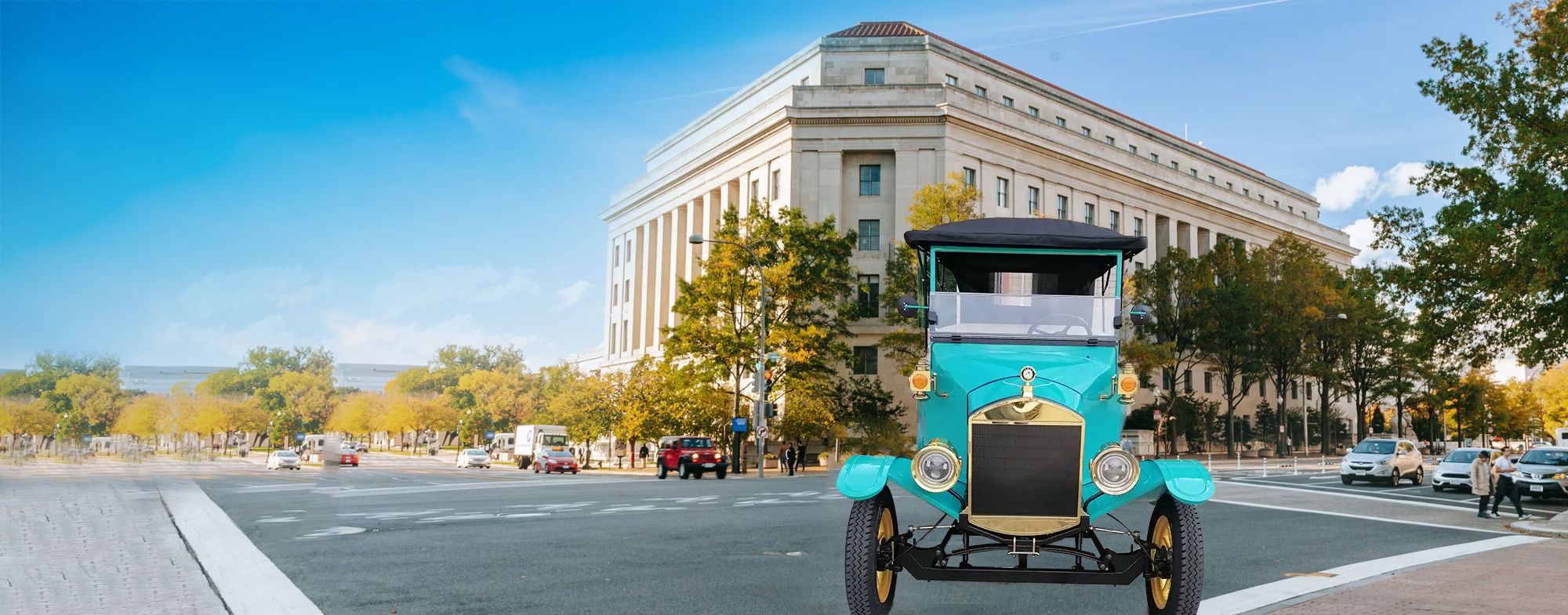
Discover the National Museum of African American private tour experience in Washington DC and explore a landmark institution dedicated to African American history, culture, achievement, and storytelling. From thought-provoking exhibitions and historic artifacts to powerful personal stories, the museum offers visitors a deeper understanding of the African American experience and its role in shaping the United States.
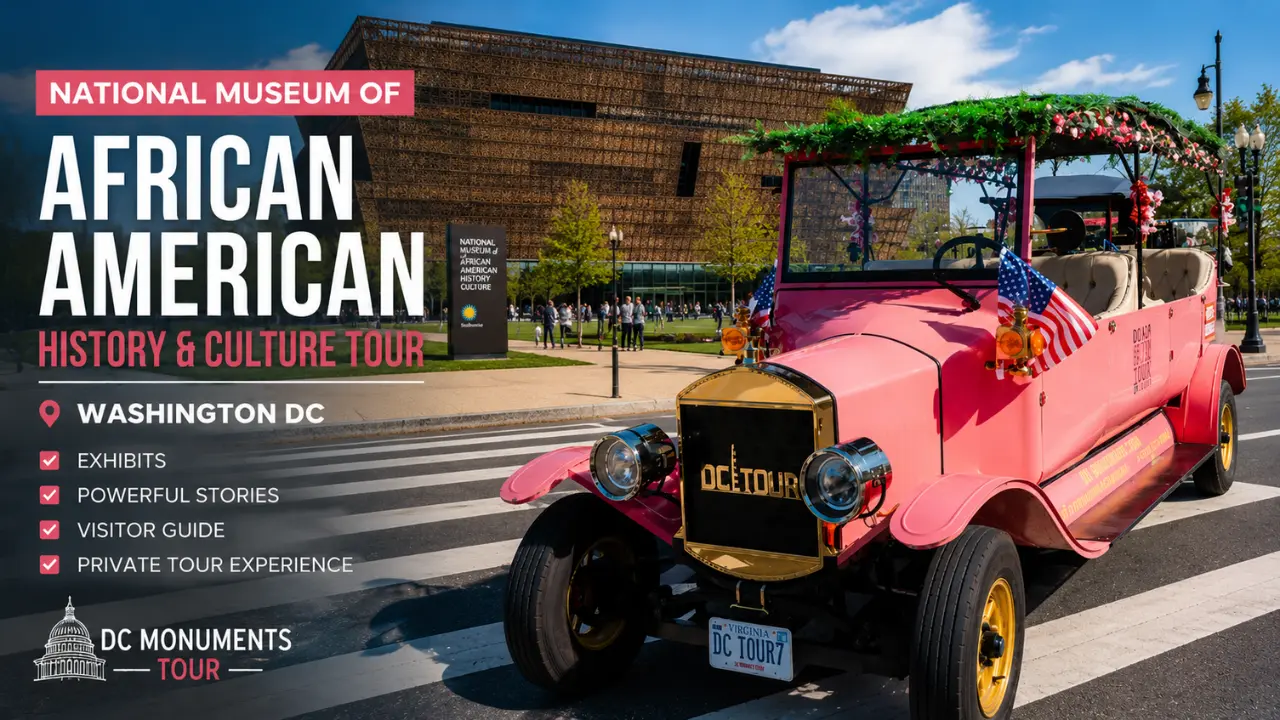
Table of Contents
- Introduction
- Why Trust This Guide?
- Visitor Information
- Quick Facts About the National Museum of African American History and Culture
- What Is the National Museum of African American History and Culture?
- The Story Behind the Museum
- What Can You See Inside?
- Notable Objects and Artifacts
- Why Visit the Museum?
- Why Choose a National Museum of African American Private Tour?
- Why Explore Washington DC by Private Luxury Vintage Car?
- Museum Visit vs Private Sightseeing Tour
- Who Should Visit NMAAHC?
- Best Time to Visit the Museum
- How Long Should You Spend at NMAAHC?
- Suggested Washington DC Itinerary
- Nearby Washington DC Attractions
- How to Reach the National Museum of African American History and Culture
- Accessibility at the Museum
- Essential Visitor Tips
- Common Mistakes Visitors Should Avoid
- How a Private Tour Can Enhance Your Washington DC Visit
- Why This Museum Matters to Your Washington DC Experience
- Why Choose DC Monuments Tour?
- Plan Your National Museum of African American Private Tour
- Final Thoughts
- Official Visitor Resources
- Frequently Asked Questions
Introduction
Washington DC is home to some of America's most important museums and landmarks, but few offer an experience as extensive and thought-provoking as the National Museum of African American History and Culture. Located on the National Mall, the Smithsonian museum explores African American life through historical objects, personal stories, art, music, cultural traditions, and experiences that have helped shape the United States.
For travelers planning a National Museum of African American private tour, understanding how to approach the museum can make the experience considerably more rewarding. The museum is large, its galleries cover different periods and themes, and exploring the entire institution can take several hours.
The National Museum of African American History and Culture is the only national museum devoted exclusively to documenting African American life, history, and culture. It was established through an Act of Congress in 2003 and opened to the public on September 24, 2016. The museum says its collection contains more than 45,000 artifacts.
This guide explains what to expect from a visit, highlights important exhibitions and stories, provides practical visitor information, and explains how a private sightseeing experience can complement your time at the museum without replacing the museum's own exhibitions, programs, or admission requirements.
Why Trust This Guide?
Planning a museum visit is easier when information comes directly from authoritative sources. This guide uses current visitor information published by the Smithsonian and the National Museum of African American History and Culture, including admission requirements, hours, transportation information, accessibility guidance, exhibitions, and visitor recommendations.
Because museum hours, exhibitions, programs, and entry procedures can change, visitors should always verify the latest information before their trip. The Smithsonian currently states that free timed-entry passes are required for all visitors, with advance passes released on a rolling basis.
Visitor Information
| Information | Details |
|---|---|
| Museum | National Museum of African American History and Culture |
| Location | 1400 Constitution Ave. NW, Washington, DC |
| Admission | Free timed-entry passes required |
| Current Hours | Monday: 12:00 PM–5:30 PM; Tuesday–Sunday: 10:00 AM–5:30 PM |
| Last Entry | 4:00 PM |
| Nearest Metro Stations | Federal Triangle and Smithsonian |
| Located On | National Mall |
| Museum Type | Smithsonian National Museum |
| Recommended Visit | Allow several hours for a meaningful visit |
The Smithsonian currently lists the museum at 1400 Constitution Avenue NW. It is open daily, with different Monday hours, and visitors must enter by 4:00 PM. Free timed-entry passes are required.
Quick Facts About the National Museum of African American History and Culture
| Category | Details |
|---|---|
| Established | 2003 by an Act of Congress |
| Opened | September 24, 2016 |
| Location | National Mall, Washington DC |
| Collection | More than 45,000 artifacts |
| Admission | Free with timed-entry pass |
| Museum Focus | African American life, history, culture, art, and contributions |
| Nearest Metro | Federal Triangle and Smithsonian |
| Parking | No Smithsonian public parking facility on the National Mall |
| Museum Experience | Historical galleries, culture galleries, exhibitions, programs, artifacts, and stories |
What Is the National Museum of African American History and Culture?
The National Museum of African American History and Culture, commonly known as NMAAHC, is part of the Smithsonian Institution and is dedicated exclusively to documenting and interpreting African American experiences.
The museum's mission goes beyond presenting individual historical events. Its exhibitions connect personal experiences, scholarship, art, objects, and cultural traditions to broader American stories. The Smithsonian describes the museum as a place where visitors can explore the contributions, struggles, resilience, and achievements that have shaped the nation.
That broad approach is one reason the museum appeals to history enthusiasts, families, educators, international visitors, photographers, and travelers looking for a deeper understanding of Washington DC.
The Story Behind the Museum
The creation of the museum followed decades of efforts to establish a national institution dedicated to African American history and culture. Congress formally established the museum in 2003, and the building opened to the public in 2016 as the 19th museum of the Smithsonian Institution.
Its opening represented an important moment in the preservation and presentation of African American stories on a national stage. Rather than focusing on a single period, the museum presents a broad journey that connects slavery and freedom, segregation, military service, civil rights, artistic expression, community life, and contemporary experiences.
What Can You See Inside?
A National Museum of African American private tour can be particularly useful as part of a wider Washington DC sightseeing itinerary, but visitors should allow enough time to explore the museum itself. The Smithsonian notes that touring the History Galleries in their entirety takes approximately two hours and involves about one mile of walking.
The museum's exhibitions change and evolve, so visitors should check the official exhibition schedule before their visit. Current exhibition information includes both long-running galleries and newer cultural exhibitions.
1. Slavery and Freedom
The Slavery and Freedom exhibition examines one of the most consequential chapters of American history. It explores the experiences of enslaved people, the systems that supported slavery, resistance, emancipation, and the long-term consequences of slavery.
The museum also offers a Slavery and Freedom Highlights Tour on selected dates, providing an additional way for visitors to engage with this section when programs are available.
2. Defending Freedom, Defining Freedom
This gallery examines the era of segregation from 1876 to 1968 and explores the ways African Americans challenged discrimination and pursued greater freedom and equality.
The exhibition connects political and social developments with individual experiences, helping visitors understand how major events affected everyday lives.
3. Making a Way Out of No Way
Making a Way Out of No Way focuses on African American resilience, community building, creativity, and achievement. The gallery demonstrates how individuals and communities created opportunities despite social and institutional barriers.
The museum has also offered highlights tours focused on this exhibition, subject to its current program schedule.
4. Cultural Expressions
Cultural Expressions explores the ways African American identity and creativity have been expressed through style, food, art, movement, and language.
The exhibition provides a different perspective from the chronological historical galleries by showing how cultural expression can communicate identity, memory, community, and creativity.
5. Taking the Stage
Taking the Stage explores African American achievements in entertainment and performance. The exhibition looks at artists and performers who have influenced American culture through stage and screen while using their platforms to inspire audiences and contribute to social change.
6. Revelation: A Journey into Abstraction
Revelation: A Journey into Abstraction opened in June 2026 and explores abstract art created by African American artists from the mid-20th century to the present. It offers visitors an opportunity to explore artistic approaches that move beyond literal representation.
7. Reset
Reset: Abstraction Embodied in Design also opened in June 2026. The exhibition examines abstract design through objects such as furniture, rugs, and lighting, considering how everyday spaces can become places of reflection and renewal.
Notable Objects and Artifacts
One of the most powerful aspects of the museum is its collection. Instead of learning only through text panels, visitors encounter physical objects connected to real people, communities, and historical events.
The Smithsonian highlights objects including Harriet Tubman's shawl, Nat Turner's Bible, a plantation cabin from South Carolina, a guard tower from Angola Prison, and Chuck Berry's red Cadillac convertible. The museum also holds works by artists including Elizabeth Catlett, Romare Bearden, Charles Alston, and Henry O. Tanner.
These objects provide tangible connections to stories that can otherwise feel distant when viewed only through books or photographs.
Why Visit the Museum?
There are many reasons to include NMAAHC in a Washington DC itinerary. It is not simply another stop on the National Mall; it provides an opportunity to explore a substantial part of the American story through a specifically African American lens.
- Explore one of the Smithsonian's most distinctive museums.
- Learn from historical artifacts and personal stories.
- Discover African American contributions to American culture.
- Explore exhibitions covering slavery, freedom, segregation, civil rights, and cultural expression.
- See significant objects connected to influential people and communities.
- Experience art, music, foodways, fashion, language, and other forms of cultural expression.
- Combine the museum with nearby National Mall attractions.
- Use a private sightseeing tour to make transportation between landmarks easier.
Why Choose a National Museum of African American Private Tour?
A National Museum of African American private tour can be a practical option for travelers who want to include NMAAHC within a broader Washington DC sightseeing experience.
A private tour does not replace the museum's required timed-entry pass or its internal exhibitions. Instead, it can provide comfortable transportation and sightseeing before or after your museum visit, allowing you to combine NMAAHC with other important landmarks around the National Mall.
For visitors traveling with family, couples, seniors, or small private groups, private transportation can also reduce the amount of walking required between attractions. This is particularly useful because the Smithsonian notes that the complete History Galleries involve approximately one mile of walking.
Your private sightseeing tour and your museum admission are separate experiences. You still need the museum's required timed-entry pass to enter NMAAHC. Always check the Smithsonian's official visitor information before your scheduled visit.
Why Explore Washington DC by Private Luxury Vintage Car?
Washington DC's National Mall contains numerous major landmarks within a relatively concentrated area, but visiting several sites can involve considerable walking. A private luxury vintage car tour provides an alternative way to move between selected sightseeing stops.
For travelers booking a National Museum of African American private tour, a private vintage sightseeing experience can complement the museum visit by providing transportation and guided sightseeing around the surrounding National Mall.
- Private sightseeing experience
- Comfortable transportation between selected landmarks
- Personalized sightseeing pace
- Local historical commentary
- Convenient photography stops
- Less walking between major outdoor attractions
- Ideal for couples, families, and small groups
- Easy way to combine several Washington DC landmarks
The key advantage is convenience: instead of treating every attraction as an isolated stop, visitors can build a more efficient sightseeing experience around their museum reservation.
Museum Visit vs Private Sightseeing Tour
| Feature | Museum Visit | Private Sightseeing Tour |
|---|---|---|
| Main Focus | Exhibitions, artifacts, stories, and galleries | Washington DC landmarks and outdoor sightseeing |
| Location | NMAAHC | National Mall and surrounding landmarks |
| Entry Requirement | Free timed-entry pass required | Depends on the selected tour |
| Transportation | Visitors arrange their own transportation | Private sightseeing transportation |
| Walking | Walking required inside the museum | Designed to reduce walking between outdoor stops |
| Experience | Self-guided museum exploration and museum programs | Personalized sightseeing with local commentary |
Who Should Visit NMAAHC?
The museum welcomes a wide range of visitors. Its subject matter makes it particularly valuable for travelers who want to understand how African American experiences have influenced American society and culture.
- First-time Washington DC visitors
- History enthusiasts
- Families with older children and teenagers
- Teachers and students
- International travelers
- Art and culture enthusiasts
- Visitors interested in civil rights history
- Travelers interested in African American heritage
- Photographers and architecture enthusiasts
- Couples and private groups
Best Time to Visit the Museum
The best time depends on your priorities. If you want a quieter experience, weekdays can be preferable to peak weekend periods. The museum specifically notes that its highest visitation is generally from noon to 4 PM Friday through Sunday, when longer lines may occur for the History Galleries.
| Timing | Why Consider It |
|---|---|
| Weekday Morning | Useful for visitors seeking a less crowded experience. |
| Weekday Afternoon | Convenient for combining the museum with other sightseeing. |
| Friday–Sunday | Popular period with potentially higher visitor volumes. |
| Fall/Winter | Can offer a more comfortable outdoor sightseeing experience with potentially fewer crowds. |
How Long Should You Spend at NMAAHC?
There is no single ideal duration because visitors have different interests. However, the Smithsonian states that exploring the History Galleries in their entirety takes approximately two hours and requires about one mile of walking.
Visitors who want to explore additional culture exhibitions, temporary exhibitions, museum programs, the museum store, and Sweet Home Café should consider allowing additional time.
For travelers combining NMAAHC with a National Museum of African American private tour, it is sensible to avoid scheduling outdoor sightseeing too tightly around the museum reservation. Giving yourself extra time creates a more relaxed itinerary.
Suggested Washington DC Itinerary
| Time | Activity |
|---|---|
| Morning | Arrive near the National Mall and prepare for museum entry. |
| 10:00 AM | Begin your scheduled NMAAHC visit, depending on your timed-entry reservation. |
| 12:30 PM | Continue exploring exhibitions or take a break for lunch. |
| 2:00 PM | Begin outdoor Washington DC sightseeing. |
| 2:30 PM | Visit nearby National Mall landmarks and photography stops. |
| 4:00 PM | Continue private sightseeing toward additional monuments. |
| Evening | Finish with additional landmark views or return to your accommodation. |
This is only a sample structure. Your actual itinerary should be adjusted according to your timed-entry reservation, museum programs, weather, mobility requirements, and preferred attractions.
Nearby Washington DC Attractions
NMAAHC's location on the National Mall makes it convenient to combine your museum visit with several major Washington DC landmarks.
1. Washington Monument
The Washington Monument stands prominently near the National Mall and is one of the city's most recognizable landmarks. Its location makes it a natural addition to a sightseeing itinerary surrounding NMAAHC.
You May Also Like:: White House Tour in Washington DC: Tips for a Smooth & Memorable Experience
2. World War II Memorial
The World War II Memorial honors Americans who served during the Second World War. Its open-air setting and location near the Reflecting Pool make it a popular sightseeing stop.
3. Lincoln Memorial
The Lincoln Memorial is one of Washington DC's most recognizable landmarks. Visitors can admire its architecture, the famous seated Lincoln sculpture, and views across the Reflecting Pool.
4. Martin Luther King Jr. Memorial
The Martin Luther King Jr. Memorial provides another important perspective on America's civil rights movement and can complement a visit to NMAAHC.
5. Vietnam Veterans Memorial
The Vietnam Veterans Memorial offers a quieter and deeply reflective experience on the National Mall, making it another meaningful stop on a Washington DC sightseeing route.
How to Reach the National Museum of African American History and Culture
The museum is located at 1400 Constitution Avenue NW, Washington, DC. The Smithsonian recommends public transportation, and the closest Metro stations are Federal Triangle and Smithsonian.
There is no public parking facility provided by the Smithsonian for its museums on the National Mall. A limited number of city-operated metered spaces are available, including accessible parking spaces.
If you are combining the museum with a private Washington DC sightseeing tour, confirm the meeting point and timing with your tour provider before your visit.
Accessibility at the Museum
The museum provides accessibility services for visitors with different mobility, vision, and other access needs. The Smithsonian notes that the museum has a substantial amount of exhibition space and that visitors should be prepared to stand or walk for extended periods. Manual wheelchairs are available to help visitors navigate the museum.
For visitors with limited mobility, the museum provides route options that can reduce the physical demands of navigating the galleries. Visitors should review the latest accessibility information before arrival, particularly if they have specific requirements.
You May Also Like:: Jefferson Memorial Tour Washington DC: A Relaxing Way to Explore the National Mall
Essential Visitor Tips
- Reserve your free timed-entry pass before visiting.
- Check the official Smithsonian website for current hours and exhibitions.
- Arrive according to the time shown on your pass.
- Allow enough time to explore the History Galleries.
- Wear comfortable shoes because the museum requires substantial walking.
- Carry a refillable water bottle where permitted.
- Check security and prohibited-item information before arrival.
- Consider visiting on a weekday if you prefer potentially lower crowds.
- Do not schedule outdoor sightseeing too tightly around your museum entry.
- Use public transportation or arrange convenient transportation in advance.
- Check accessibility information if you have mobility requirements.
- Plan time to reflect rather than rushing through the exhibitions.
The Smithsonian recommends eating and hydrating before entering the History Galleries because of the amount of walking involved.
Common Mistakes Visitors Should Avoid
- Arriving without a required timed-entry pass.
- Assuming the museum can be fully explored in one hour.
- Trying to combine too many attractions into a single afternoon.
- Wearing uncomfortable footwear.
- Ignoring current exhibition schedules.
- Forgetting that museum admission and private sightseeing tours are separate experiences.
- Planning a tight itinerary without accounting for security and visitor lines.
- Not checking accessibility information ahead of time.
- Arriving too late to comfortably explore the galleries.
- Skipping time for reflection and reading the stories accompanying important objects.
How a Private Tour Can Enhance Your Washington DC Visit
A private sightseeing experience can add value before or after your museum visit by helping you explore the outdoor landmarks surrounding NMAAHC.
Instead of spending your entire day walking from one National Mall attraction to another, you can use private transportation to move between selected stops while your guide provides historical context and helps organize photography opportunities.
This approach works particularly well for travelers who want a more personalized experience. Families can maintain their own pace, couples can enjoy a more intimate sightseeing experience, and older visitors can reduce unnecessary walking between outdoor landmarks.
For travelers searching specifically for a National Museum of African American private tour, the best approach is to treat the museum itself as the core indoor experience and the private tour as a complementary way to discover the surrounding landmarks.
Why This Museum Matters to Your Washington DC Experience
Washington DC is often described through its monuments and government buildings, but understanding the city also means understanding the diverse experiences that have shaped the United States.
NMAAHC contributes an important perspective by bringing together historical documentation, personal experiences, art, material culture, and scholarship. Its collections and exhibitions provide visitors with opportunities to examine both difficult chapters and remarkable achievements within the broader American story.
That makes the museum particularly valuable for travelers who want more than photographs of famous landmarks. It provides context that can make a Washington DC trip more meaningful.
You May Also Like:: Smithsonian Castle Tour in Washington DC: Explore DC’s Iconic Red-Sandstone Landmark
Why Choose DC Monuments Tour?
At DC Monuments Tour, we focus on making Washington DC sightseeing comfortable, personal, and convenient. Our private sightseeing experience is designed for travelers who want to explore the National Mall and surrounding landmarks without spending the entire day walking between attractions.
A private luxury vintage car experience can complement your NMAAHC visit by helping you explore nearby monuments and landmarks before or after your museum reservation.
- Private sightseeing experience
- Comfortable vintage transportation
- Personalized route options
- Local historical commentary
- Convenient photography stops
- Less walking between outdoor attractions
- Ideal for couples, families, and small groups
- Easy way to combine National Mall landmarks
Plan Your National Museum of African American Private Tour
Planning a visit to NMAAHC is about more than simply checking another museum off your Washington DC itinerary. The exhibitions, artifacts, and personal stories provide an opportunity to explore important parts of the American experience through the lens of African American history and culture.
Start by reserving your required free timed-entry pass directly through the Smithsonian. Then build your wider Washington DC sightseeing itinerary around your museum reservation.
A National Museum of African American private tour can complement that experience by providing comfortable transportation and personalized outdoor sightseeing around the National Mall.
Plan your Washington DC sightseeing experience and discover the stories, landmarks, and places that make the nation's capital unique.
Final Thoughts
The National Museum of African American History and Culture is one of Washington DC's most significant cultural institutions. From its extensive historical galleries and meaningful artifacts to its exhibitions celebrating African American creativity and achievement, the museum offers an experience that can stay with visitors long after they leave.
Because the museum is extensive, thoughtful planning matters. Reserve your free timed-entry pass, allow enough time to explore, wear comfortable shoes, and check the Smithsonian's latest visitor information before arriving.
For travelers who also want to experience Washington DC's outdoor landmarks, a private sightseeing tour can complement the museum visit by providing comfortable transportation, personalized sightseeing, and convenient access to nearby National Mall attractions.
Whether you're visiting Washington DC for the first time or returning to explore it from a different perspective, combining NMAAHC with a carefully planned private sightseeing experience can create a more complete and memorable trip.
Official Visitor Resources
For the most current admission requirements, hours, exhibitions, accessibility information, and visitor policies, consult the National Museum of African American History and Culture's official visitor information.
For current exhibitions, programs, and museum background, refer to the Smithsonian's official museum resources.
You May Also Like:: Lincoln Memorial Tour Washington DC: A Journey Through America's Most Iconic Monument