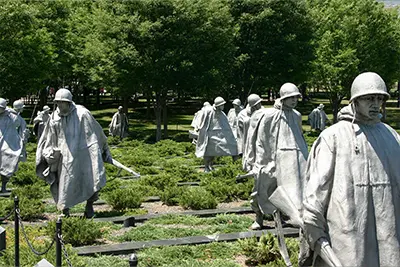
Featuring 19 life-like soldier statues. This memorial pays homage to the resilience of those who served in one of America’s defining conflicts. Witness an experience that leaves an impression to your heart. With our tour packages, you get to experience the stories of these courageous fallen soldiers.
The Korean War Veterans Memorial is one of the most distinctive war memorials on the National Mall in Washington DC. Located near the Lincoln Memorial and World War II Memorial, it honors the men and women who served in the Korean War and remembers those who made the ultimate sacrifice.
Dedicated on July 27, 1995, the memorial uses 19 stainless-steel soldier statues, a granite mural wall, a Pool of Remembrance, and inscriptions to tell the story of the Korean War. The statues appear to move through a field of juniper bushes, creating an experience that is different from the more traditional architectural style of many Washington DC monuments.
Explore a private Washington DC tour with DC Monuments Tour to see the Korean War Veterans Memorial alongside other major monuments and memorials with a local guide.
About the Korean War Veterans Memorial
The Korean War Veterans Memorial is located on the National Mall, southeast of the Lincoln Memorial Reflecting Pool. It sits near the World War II Memorial and Vietnam Veterans Memorial, making it an important stop on a Washington DC military history sightseeing route.
The memorial was designed by a team of architects and artists led by Cooper-Lecky Architects. Its design focuses on the experience of ordinary soldiers rather than a single famous commander or political leader.
The central feature is a field of 19 stainless-steel soldier statues. The figures represent an infantry patrol moving through the difficult terrain of Korea. Their clothing, equipment, facial expressions, and positions are designed to communicate the uncertainty and hardship experienced by service members.
A large granite mural wall stands alongside the statues. The wall contains photographic images etched into the stone, creating a visual connection between the individual soldiers and the wider military effort.
Korean War Veterans Memorial Quick Facts
- Dedicated to: Veterans who served in the Korean War
- Dedicated: July 27, 1995
- Location: National Mall, Washington DC
- Architectural team: Cooper-Lecky Architects and associated artists
- Main sculpture: 19 stainless-steel soldier statues
- Branch representation: Army, Marine Corps, Navy, and Air Force personnel
- Main features: Soldier statues, granite mural wall, Pool of Remembrance, Wall of Remembrance and inscriptions
- Entrance fee: Free
- Hours: Open 24 hours a day
- Accessibility: Wheelchair accessible
Why Is the Korean War Veterans Memorial Important?
The Korean War Veterans Memorial is important because it recognizes the service and sacrifice of Americans who fought during the Korean War, a conflict that is sometimes described as the "Forgotten War."
The Korean War began in 1950 after North Korean forces crossed the 38th parallel into South Korea. United Nations forces, including American troops, fought alongside South Korean forces during the conflict.
The war ended with an armistice in 1953 rather than a formal peace treaty. The Korean Peninsula remains divided, making the memorial's message of service and sacrifice especially significant.
Instead of presenting the war only through dates and military statistics, the memorial focuses on the individual soldier. The 19 statues create the impression of a patrol moving through difficult terrain, helping visitors imagine the conditions faced by service members.
The memorial also recognizes the broader international contribution to the conflict. The United Nations Wall acknowledges the countries that supported South Korea during the war.
Korean War Veterans Memorial Design & Architecture
The design of the Korean War Veterans Memorial is intentionally different from many traditional Washington DC memorials.
Rather than placing a single statue or large building at the center, the memorial creates a landscape through sculpture, reflective surfaces, granite, landscaping, and open space.
The 19 stainless-steel soldiers form the heart of the memorial. They represent a patrol moving through terrain similar to the Korean landscape. The figures include members of different military branches and reflect the diversity of the forces that served.
The statues are positioned in a triangular field bordered by low vegetation. Their realistic appearance, equipment, and expressions make the experience feel personal rather than purely ceremonial.
The granite mural wall runs alongside the statues. More than 2,400 photographic images were selected to represent the people who supported the Korean War effort, including soldiers, medical personnel, and other participants.
When viewed from the right angle, the photographic images etched into the polished granite appear to merge with the stainless-steel soldiers. This creates a visual connection between the individual service members and the larger military operation.
The 19 Soldier Statues at the Korean War Memorial
The 19 stainless-steel soldier statues are the most recognizable feature of the Korean War Veterans Memorial.
The figures represent a patrol moving through a field. They include members of the Army, Marine Corps, Navy, and Air Force, although the majority of the figures represent Army personnel.
The soldiers carry equipment associated with the Korean War period, including weapons, backpacks, helmets, and field gear. Their facial expressions and body positions convey alertness and uncertainty.
The statues are approximately seven feet tall, making them larger than life-size. Their scale allows visitors to walk among the figures rather than simply viewing them from a distance.
The number 19 is also significant because the 19 statues and the 164 figures on the mural wall can create the appearance of 38 soldiers when reflected together. The number 38 recalls the 38th parallel, an important geographic reference in the Korean War.
What Do the Korean War Memorial Soldiers Represent?
The soldiers represent a patrol moving through the rugged terrain of Korea during the war.
The figures are deliberately shown in motion rather than standing in a formal military formation. Some look ahead while others appear to observe the surrounding landscape.
The arrangement creates a sense of uncertainty and tension. Visitors walking among the statues experience the memorial at approximately the same human scale as the figures.
The statues represent different branches of the U.S. armed forces and emphasize the cooperation required during the conflict.
Korean War Memorial Mural Wall
The granite mural wall is another major feature of the Korean War Veterans Memorial.
The wall is approximately 164 feet long and contains thousands of photographic images etched into its polished surface.
The photographs were selected from wartime images and show people involved in the Korean War, including service members and support personnel.
The reflective granite creates an unusual visual effect. When visitors stand near the wall, the etched images can appear to blend with the stainless-steel soldier statues across the memorial.
This connection helps communicate an important idea: the individual soldiers represented by the statues were part of a much larger military and national effort.
Wall of Remembrance
The Wall of Remembrance was added to the Korean War Veterans Memorial as part of the memorial's expansion and provides a more detailed record of those who served and died during the Korean War.
The wall includes the names of U.S. military personnel and Korean Augmentation to the United States Army, or KATUSA, service members who died during the conflict.
Visitors can use the Wall of Remembrance to connect the large historical story of the Korean War with individual people who served.
Pool of Remembrance
The Pool of Remembrance provides a quieter space within the Korean War Veterans Memorial.
The circular pool is surrounded by inscriptions and landscaping and provides a place for visitors to pause after walking through the soldier field.
The memorial's reflective surfaces and landscaping create a more contemplative atmosphere here than in the central sculpture area.
The Pool of Remembrance also includes statistics about the human cost of the Korean War, providing important context for the memorial.
Korean War Veterans Memorial Inscriptions & Quotes
Words play an important role in the Korean War Veterans Memorial.
One of the most recognizable inscriptions appears on the granite wall behind the soldiers: "Freedom Is Not Free."
The phrase summarizes the central message of the memorial. The freedom enjoyed by later generations came with a cost paid by the service members who fought and died during the conflict.
Another important inscription identifies the memorial as a tribute to the veterans who served in the Korean War.
The memorial also includes information about the countries that participated in the United Nations effort, emphasizing the international nature of the conflict.
Why Is the Korean War Called the Forgotten War?
The Korean War is often called the "Forgotten War" because it received less attention in American popular culture and public memory than World War II and the Vietnam War.
The conflict lasted from 1950 to 1953 and resulted in significant military and civilian casualties. More than 36,000 U.S. service members died during the war.
The Korean War Veterans Memorial helps ensure that the service of those veterans is remembered.
The memorial's focus on ordinary soldiers rather than only military leaders makes the human experience of the war central to the visitor experience.
Where Is the Korean War Veterans Memorial?
The Korean War Veterans Memorial is located on the National Mall in Washington DC, near the Lincoln Memorial and Reflecting Pool.
Address: 900 Ohio Drive SW, Washington, DC 20024
The memorial is positioned near several other major military memorials, including the World War II Memorial and Vietnam Veterans Memorial.
Its location makes it easy to include in a broader National Mall sightseeing route.
For a wider overview of major landmarks, see our guide to the best Washington DC monuments to visit in 2026.
Korean War Veterans Memorial Hours & Admission
The Korean War Veterans Memorial is open 24 hours a day, every day of the year.
There is no entrance fee or pass required to visit the memorial.
Because the memorial is outdoors, visitors should prepare for changing Washington DC weather. Summer temperatures can be hot and humid, while winter visits can be cold and windy.
Visiting early in the morning or later in the evening can provide a quieter experience, especially during busy periods on the National Mall.
Is the Korean War Veterans Memorial Accessible?
Yes. The Korean War Veterans Memorial is wheelchair accessible.
The memorial's pathways allow visitors to move through the main areas and view the soldier statues, mural wall, and other features.
Visitors with specific accessibility requirements should check current National Park Service information before visiting, particularly if they need additional services or assistance.
Our Washington DC accessibility guide provides additional information about visiting National Mall attractions.
Best Time to Visit the Korean War Veterans Memorial
The memorial is open around the clock, so visitors can choose a time that fits their sightseeing itinerary.
Early Morning
Early morning is a good option for visitors who prefer a quieter atmosphere. The softer light can also create interesting reflections on the polished granite and stainless-steel statues.
Afternoon
Afternoon visits work well when the memorial is included in a larger National Mall itinerary. You can combine it with the Lincoln Memorial, Vietnam Veterans Memorial, World War II Memorial, and Washington Monument.
Sunset
Sunset can create dramatic light across the soldier statues and mural wall. It is also a comfortable time to explore the memorial during warmer months.
Night
The Korean War Veterans Memorial is open 24 hours. At night, lighting changes the appearance of the statues and creates a quieter, more reflective atmosphere.
For more ideas about exploring Washington DC after dark, read our guide to Washington DC night tours and places to visit after dark.
How Long Does It Take to Visit the Korean War Veterans Memorial?
Most visitors can explore the Korean War Veterans Memorial in approximately 20 to 40 minutes.
A quick visit may take around 15 to 20 minutes if you want to see the soldier statues, mural wall, and main inscriptions.
Allow 30 to 45 minutes if you want to walk around the memorial, examine the photographic mural, read the inscriptions, visit the Pool of Remembrance, and spend time reflecting on the memorial.
If you are visiting several nearby war memorials, you can easily include the Korean War Veterans Memorial as part of a larger National Mall sightseeing route.
Nearby Attractions to Combine With the Korean War Memorial
The Korean War Veterans Memorial is surrounded by some of Washington DC's most important monuments and memorials.
Lincoln Memorial
The Lincoln Memorial is located immediately northwest of the Korean War Veterans Memorial.
The two sites can easily be visited together because of their close proximity.
Explore our Lincoln Memorial tour guide for more information about its history and significance.
Vietnam Veterans Memorial
The Vietnam Veterans Memorial is located nearby and provides another important perspective on American military history.
The contrast between the Korean War Memorial's three-dimensional soldiers and the Vietnam Memorial's minimalist black granite wall makes visiting both sites particularly meaningful.
Read our Vietnam Veterans Memorial tour guide to learn more.
World War II Memorial
The World War II Memorial is located east of the Korean War Veterans Memorial along the National Mall.
Its 56 pillars, Atlantic and Pacific arches, Rainbow Pool, and Freedom Wall create a very different architectural experience.
Learn more in our World War II Memorial tour guide.
Washington Monument
The Washington Monument is one of the most recognizable landmarks on the National Mall and can be included in the same sightseeing route.
Its location near the World War II Memorial makes it a natural stop before or after exploring the war memorials.
Franklin Delano Roosevelt Memorial
The Franklin Delano Roosevelt Memorial is located farther east near the Tidal Basin. Its waterfalls, sculptures, and chronological outdoor rooms provide a different style of memorial experience.
Explore our Franklin Delano Roosevelt Memorial guide for more information.
Martin Luther King Jr. Memorial
The Martin Luther King Jr. Memorial is also located along the Tidal Basin. It honors Dr. King and his role in the American civil rights movement.
Our Martin Luther King Jr. Memorial tour guide provides more information about this nearby landmark.
Explore the Korean War Veterans Memorial With DC Monuments Tour
The Korean War Veterans Memorial is easier to appreciate when you understand the meaning behind the 19 soldier statues, granite mural, Freedom Is Not Free inscription, and Wall of Remembrance.
DC Monuments Tour includes the Korean War Veterans Memorial among the major Washington DC landmarks featured in its sightseeing experiences. A local guide can help explain the history of the Korean War while you explore the wider National Mall.
Our Washington DC Day Tour is a convenient option for visitors who want to see several major landmarks during one sightseeing experience.
For visitors who prefer a more personalized experience, our Private Washington DC Tours provide a flexible way to explore the city's monuments and memorials.
You can also explore Washington DC after dark with our Washington DC Night Tour.
Why Visit the Korean War Veterans Memorial?
The Korean War Veterans Memorial is worth visiting because it creates a powerful connection between American military history and the individual soldiers who served.
- See the 19 soldier statues: Walk among the stainless-steel figures representing a Korean War patrol.
- Explore the mural wall: See thousands of photographic images etched into polished granite.
- Read "Freedom Is Not Free": Experience one of the memorial's most recognizable inscriptions.
- Visit the Wall of Remembrance: Learn about individual service members who died during the conflict.
- Reflect at the Pool of Remembrance: Spend time in one of the memorial's quieter areas.
- Understand the Korean War: Learn about a conflict that is sometimes overlooked in American history.
- Visit day or night: The memorial is open 24 hours a day.
- Combine nearby landmarks: Visit the Lincoln Memorial, Vietnam Veterans Memorial, World War II Memorial, and other National Mall attractions during the same trip.
Book Your Washington DC Monuments Tour
The Korean War Veterans Memorial is more than a collection of statues. It is a tribute to the service members who fought in a difficult conflict and to the sacrifices made during a war that shaped the modern Korean Peninsula.
From the 19 stainless-steel soldiers and photographic mural to the Pool of Remembrance, Wall of Remembrance, and powerful "Freedom Is Not Free" inscription, every part of the memorial contributes to its message of service, sacrifice, and remembrance.
Explore the Korean War Veterans Memorial and other iconic landmarks with DC Monuments Tour.
Choose from our Washington DC sightseeing tours and experience the history of the nation's capital with a knowledgeable local guide.