
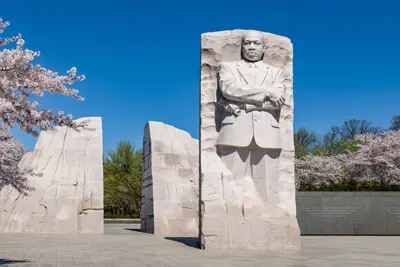
A tribute worthy of the man who changed the United States of America forever. A towering statue of stone symbolizes hope and courage in the hearts of all Americans. Our Private Washington DC Tours guides will tell you his vision and the leadership in the Civil Rights Movement.
The Martin Luther King Jr. Memorial is one of the most powerful landmarks in Washington DC, honoring the life, leadership, and legacy of Dr. Martin Luther King Jr. Located along the Tidal Basin near the National Mall, the memorial recognizes his commitment to freedom, equality, justice, and nonviolent social change.
The centerpiece of the memorial is a 30-foot-tall statue of Dr. King carved into the Stone of Hope. Behind him, the Mountain of Despair represents the obstacles faced during the struggle for civil rights. Together, these elements create one of Washington DC's most recognizable and meaningful memorial spaces.
Explore the private Washington DC tours with DC Monuments Tour to visit the Martin Luther King Jr. Memorial alongside other major monuments with a knowledgeable local guide.
About the Martin Luther King Jr. Memorial
The Martin Luther King Jr. Memorial is located at the intersection of Independence Avenue and West Basin Drive SW, close to the Tidal Basin and several other major Washington DC memorials.
The memorial honors Dr. King, one of the most influential leaders of the modern American Civil Rights Movement. His leadership emphasized nonviolent resistance in the pursuit of racial equality, economic opportunity, freedom, and justice.
The memorial was dedicated on August 28, 2011, the 48th anniversary of the historic March on Washington for Jobs and Freedom. Its location places it within the same historic landscape as the Lincoln Memorial, where Dr. King delivered his famous "I Have a Dream" speech in 1963.
Rather than simply displaying a statue, the memorial uses a carefully designed landscape to tell a story of struggle, perseverance, hope, and equality.
Martin Luther King Jr. Memorial Quick Facts
- Dedicated to: Dr. Martin Luther King Jr.
- Dedicated: August 28, 2011
- Location: West Basin Drive and Independence Avenue SW, Washington DC
- Address: 1850 West Basin Drive SW, Washington, DC 20024
- Memorial statue: 30-foot-tall statue of Dr. King
- Central sculpture: Stone of Hope
- Surrounding structure: Mountain of Despair
- Designer: Lei Yixin
- Landscape architect: Oehme, van Sweden & Associates
- Entrance fee: Free
- Hours: Open 24 hours a day
- Ranger hours: 9:30 a.m. to 10:00 p.m. daily
- Accessibility: The memorial is wheelchair accessible
Why Is the Martin Luther King Jr. Memorial Important?
The Martin Luther King Jr. Memorial honors a leader whose work changed the course of American civil rights history.
Dr. King became nationally prominent during the Montgomery Bus Boycott in 1955–56 and later became one of the most recognizable leaders of the Civil Rights Movement.
He advocated nonviolent resistance against racial segregation and discrimination and spoke extensively about equality, justice, economic opportunity, and human dignity.
On August 28, 1963, Dr. King delivered his famous "I Have a Dream" speech from the steps of the Lincoln Memorial during the March on Washington for Jobs and Freedom.
The location of the Martin Luther King Jr. Memorial is therefore particularly meaningful. Visitors can look across the Tidal Basin toward the broader National Mall landscape while remembering the movement and speech that became defining moments in American history.
Martin Luther King Jr. Memorial Design & Architecture
The memorial's design is based on imagery from Dr. King's speeches and writings. Its central concept comes from the words "Out of a mountain of despair, a stone of hope."
Visitors enter the memorial through the Mountain of Despair, represented by two large pieces of granite. From this opening, the Stone of Hope emerges toward the Tidal Basin.
The 30-foot statue of Dr. King is carved into the Stone of Hope. His figure faces toward the horizon, symbolizing the future and the continuing pursuit of equality and justice.
The memorial's granite contains natural variations in color and texture. These differences are part of the visual character of the stone and contribute to the memorial's symbolic connection with diversity.
The surrounding landscape includes open spaces, trees, pathways, benches, and views toward the Tidal Basin.
The Mountain of Despair
The Mountain of Despair forms the entrance to the memorial.
Two large granite formations create an opening through which visitors walk. The design represents the obstacles and struggles faced by people fighting for civil rights and social equality.
The rough surfaces and grooves in the granite contribute to the visual impression of struggle. Visitors move through the mountain before reaching the Stone of Hope.
This movement is intentional. Instead of immediately approaching the statue, visitors experience a physical transition from the representation of struggle toward a symbol of hope.
The Stone of Hope
The Stone of Hope is the central feature of the Martin Luther King Jr. Memorial.
Dr. King's statue emerges from the stone, creating the impression that his figure is moving forward from the Mountain of Despair.
The concept comes from Dr. King's famous 1963 speech at the Lincoln Memorial, where he spoke about hope emerging from difficulty and injustice.
The statue faces toward the Tidal Basin and the Jefferson Memorial, creating a strong visual connection with the surrounding memorial landscape.
The Stone of Hope is approximately 30 feet tall and is carved from granite. It is one of the most recognizable sculptural landmarks in Washington DC.
Dr. Martin Luther King Jr. Statue
The centerpiece of the memorial is the large sculpture of Dr. King emerging from the Stone of Hope.
His arms are folded across his chest, and his expression is serious and contemplative. The statue does not depict him speaking from a podium. Instead, it presents him as a leader reflecting on the struggle and the future.
The sculpture's position also creates a direct visual relationship with the Tidal Basin and the surrounding monuments.
For visitors interested in civil rights history, the statue is only one part of the experience. The quotations engraved throughout the memorial provide additional context about Dr. King's ideas and philosophy.
Martin Luther King Jr. Memorial Quotes
Quotations from Dr. King are engraved into the granite walls surrounding the memorial.
These inscriptions are drawn from speeches, sermons, and writings from different periods of his life. They reflect recurring themes of justice, equality, democracy, freedom, faith, and nonviolent action.
The quotations encourage visitors to move beyond the statue and engage with Dr. King's ideas.
One of the most significant sources represented at the memorial is the 1963 "I Have a Dream" speech, which Dr. King delivered at the Lincoln Memorial during the March on Washington.
As you walk through the memorial, take time to read the inscriptions rather than treating the site simply as a photo stop. The words provide much of the historical and philosophical context behind the memorial's design.
Where Is the Martin Luther King Jr. Memorial?
The Martin Luther King Jr. Memorial is located on the southwest side of the Tidal Basin in Washington DC.
Address: 1850 West Basin Drive SW, Washington, DC 20024
The memorial is positioned along West Basin Drive and Independence Avenue, making it convenient to include in a sightseeing route around the Tidal Basin and National Mall.
It is close to several major Washington DC landmarks, including the Franklin Delano Roosevelt Memorial, Jefferson Memorial, Lincoln Memorial, and Washington Monument.
You can also visit the Franklin Delano Roosevelt Memorial during the same sightseeing route around the Tidal Basin.
Martin Luther King Jr. Memorial Hours & Admission
The Martin Luther King Jr. Memorial is open 24 hours a day, every day.
There is no entrance fee or pass required to visit the memorial.
National Park Service rangers are generally available from 9:30 a.m. to 10:00 p.m. daily to answer questions and provide interpretive programs.
Because the memorial is outdoors, visitors should prepare for changing weather conditions throughout the year.
Is the Martin Luther King Jr. Memorial Accessible?
Yes. The Martin Luther King Jr. Memorial welcomes visitors with disabilities and provides accessible pathways throughout the memorial grounds.
The sidewalks are wide, and accessible parking is available near the memorial on West Basin Drive. Benches are also available around the memorial for visitors who need a place to rest.
Accessible and family restrooms are located near the memorial's bookstore.
The National Park Service also provides additional accessibility resources for visitors with mobility, hearing, vision, or other accessibility needs.
For more information about accessible sightseeing throughout the city, see our Washington DC accessibility guide.
Best Time to Visit the Martin Luther King Jr. Memorial
Because the memorial is open 24 hours, visitors have considerable flexibility when planning a visit.
Early Morning
Early morning can provide a quieter atmosphere around the Tidal Basin. It is a good option if you want more time to read the inscriptions, photograph the memorial, and reflect without larger crowds.
Afternoon
Afternoon visits work well as part of a broader National Mall sightseeing itinerary. You can combine the MLK Memorial with the FDR Memorial, Jefferson Memorial, Washington Monument, and other nearby landmarks.
Cherry Blossom Season
The Martin Luther King Jr. Memorial is particularly striking during Washington DC's cherry blossom season. Yoshino cherry trees surround the Tidal Basin, creating one of the city's most recognizable spring landscapes.
Cherry blossom season is also especially meaningful in relation to Dr. King because the annual bloom occurs around the anniversary of his death in April.
Sunset
Late afternoon and sunset can provide excellent natural light across the granite, statue, and surrounding Tidal Basin.
Night
The memorial remains open after dark and is illuminated at night. An evening visit provides a quieter atmosphere and a different perspective of the Stone of Hope and surrounding landscape.
For more nighttime sightseeing ideas, explore our guide to Washington DC night tours and places to visit after dark.
How Long Does It Take to Visit the MLK Memorial?
The National Park Service recommends allowing approximately 30 to 90 minutes for a visit to the Martin Luther King Jr. Memorial, depending on how much time you spend exploring the site.
A shorter visit is enough to see the statue, Mountain of Despair, Stone of Hope, and major inscriptions.
If you want to read the quotations, photograph the memorial, and take time to understand the design and history, allow closer to an hour or more.
Because the memorial is located near several other major landmarks, it can also be incorporated into a longer Tidal Basin or National Mall sightseeing route.
Nearby Attractions to Combine With the MLK Memorial
The Martin Luther King Jr. Memorial is surrounded by several important Washington DC landmarks, making it easy to include multiple stops in one sightseeing trip.
Franklin Delano Roosevelt Memorial
The FDR Memorial is located nearby along the Tidal Basin. Its four outdoor rooms tell the story of Franklin D. Roosevelt's presidency through sculptures, waterfalls, inscriptions, and landscape design.
Read our Franklin Delano Roosevelt Memorial guide before planning your visit.
Jefferson Memorial
The Jefferson Memorial stands on the opposite side of the Tidal Basin and is easily combined with the MLK Memorial during a walking or guided sightseeing route.
Lincoln Memorial
The Lincoln Memorial is one of the most important nearby landmarks for understanding Dr. King's legacy. It was from the steps of the Lincoln Memorial that Dr. King delivered his "I Have a Dream" speech in 1963.
Explore our Lincoln Memorial tour guide for more information.
Washington Monument
The Washington Monument is another major National Mall landmark that can be included in the same sightseeing route.
World War II Memorial
The World War II Memorial is located between the Washington Monument and Lincoln Memorial and can be combined with the MLK Memorial when planning a broader National Mall tour.
For a wider overview, see our guide to the best Washington DC monuments to visit in 2026.
Explore the Martin Luther King Jr. Memorial With DC Monuments Tour
The Martin Luther King Jr. Memorial is more meaningful when visitors understand the history behind the Mountain of Despair, Stone of Hope, statue, and engraved quotations.
DC Monuments Tour includes the Martin Luther King Jr. Memorial among its Washington DC sightseeing stops. A local guide can provide context about Dr. King's leadership and help you connect the memorial with other major landmarks across the National Mall.
Our Washington DC Day Tour includes the Martin Luther King Jr. Memorial as a featured sightseeing stop, currently listed as a 10-minute stop on the itinerary.
For visitors who prefer a more personalized sightseeing experience, our Private Washington DC Tours provide a flexible way to explore the city's monuments and memorials.
You can also see the memorial after dark with our Washington DC Night Tour.
Why Visit the Martin Luther King Jr. Memorial?
The Martin Luther King Jr. Memorial is one of the most significant memorials in Washington DC because it connects a major American leader with the broader history of civil rights and equality.
- See the Stone of Hope: View the 30-foot sculpture of Dr. King emerging from the granite.
- Walk through the Mountain of Despair: Experience the memorial's symbolic representation of the obstacles faced during the civil rights struggle.
- Read Dr. King's words: Explore quotations from his speeches and writings engraved throughout the memorial.
- Connect with civil rights history: Visit a memorial dedicated to one of the most influential leaders of the modern Civil Rights Movement.
- Enjoy the Tidal Basin setting: Experience the memorial alongside Washington DC's famous cherry trees and waterfront landscape.
- Combine nearby landmarks: Visit the FDR Memorial, Jefferson Memorial, Lincoln Memorial, and Washington Monument in the same sightseeing trip.
- Visit day or night: The memorial is open 24 hours a day.
Book Your Washington DC Monuments Tour
The Martin Luther King Jr. Memorial is more than a statue. Its Mountain of Despair, Stone of Hope, inscriptions, landscape, and position beside the Tidal Basin create a space dedicated to the continuing ideals of freedom, equality, justice, and nonviolent action.
Take time to see the statue, read Dr. King's words, and understand the symbolism behind the memorial as you explore Washington DC.
Explore the Martin Luther King Jr. Memorial and other iconic landmarks with DC Monuments Tour.
Choose from our Washington DC sightseeing tours and experience the history of the nation's capital with a knowledgeable local guide.