Explore Washington DC in one day with this history-focused itinerary covering the National Archives, Washington Monument, World War II Memorial, Vietnam Veterans Memorial, Lincoln Memorial, National Museum of American History, and White House area. Discover practical timing, route planning, transportation tips, and ways to experience America’s history without rushing.

Table of Contents
- Why Choose a History-Focused Washington DC Itinerary?
- Quick Facts: 1-Day Washington DC History Itinerary
-
1-Day American History Itinerary in Washington DC
- 9:30 AM – Start at the National Archives
- 10:45 AM – Continue Through the National Mall
- Washington Monument
- 11:15 AM – World War II Memorial
- 11:45 AM – Vietnam Veterans Memorial
- 12:15 PM – Lincoln Memorial
- 1:00 PM – Lunch Break
- 2:00 PM – National Museum of American History
- 4:30 PM – White House Area
- 5:00 PM and Beyond – Optional Evening History Stops
- The Best Route for a One-Day History Trip
- Why a Private Tour Can Work Well for History Lovers
- Should You Take a Washington DC Day Tour?
- American History You Can Experience in One Day
- How to Plan Your Washington DC History Day
- Best Washington DC Stops for Different History Interests
- What Not to Do on a One-Day History Trip
- You May Also Like
- Why Choose DC Monuments Tour for a History-Focused Trip?
- Key Takeaways
- Conclusion: Make Your One Day in Washington DC Count
- Frequently Asked Questions
Washington, DC is one of the best cities in the United States for travelers who want to experience American history in a single day. The city brings together founding documents, presidential history, civil rights landmarks, war memorials, museums, and monuments across a relatively compact area.
But trying to see everything in one day can quickly turn into a rushed checklist. A better approach is to build your day around a logical route and focus on the places that tell the biggest chapters of American history.
This 1-day Washington DC history itinerary combines the National Archives, National Mall, major memorials, and the Smithsonian's National Museum of American History. It also leaves enough flexibility for photographs, short walks, meals, and historical stops along the way.
Why Choose a History-Focused Washington DC Itinerary?
Washington, DC is more than a city of monuments. Many of its landmarks are connected to major events, people, political movements, wars, and ideas that shaped the United States.
The National Mall alone brings together a remarkable concentration of historic places. The National Park Service describes the broader National Mall area as including the Washington Monument grounds and West Potomac Park, where visitors can find the Lincoln, Jefferson, Franklin D. Roosevelt, Korean War Veterans, Vietnam Veterans, and World War II memorials.
That makes the area ideal for a one-day history itinerary. Instead of spending hours traveling between distant attractions, you can move through several important chapters of American history in one continuous sightseeing route.
Quick Facts: 1-Day Washington DC History Itinerary
| Item | Recommended Plan |
|---|---|
| Trip length | 1 full day |
| Best starting time | Around 9:30–10:00 AM |
| Primary area | National Mall and nearby historic landmarks |
| Best for | History lovers, families, couples, students, and first-time visitors |
| Main indoor stop | National Museum of American History |
| Founding-era stop | National Archives |
| Major memorials | Lincoln, Vietnam Veterans, World War II, Korean War Veterans, and others |
| Recommended transportation | Private sightseeing vehicle or a combination of walking and public transportation |
1-Day American History Itinerary in Washington DC
Here is a practical route for visitors who want to experience several major periods of American history without spending the entire day walking between attractions.
| Time | Stop | Historical Focus |
|---|---|---|
| 9:30 AM | National Archives | Declaration of Independence, Constitution, Bill of Rights |
| 10:45 AM | National Mall / Washington Monument area | Founding ideals and national identity |
| 11:15 AM | World War II Memorial | World War II and the American home front |
| 11:45 AM | Vietnam Veterans Memorial | Vietnam War and remembrance |
| 12:15 PM | Lincoln Memorial | Abraham Lincoln and the Civil War era |
| 1:00 PM | Lunch break | Rest and recharge |
| 2:00 PM | National Museum of American History | American political, cultural, military, and social history |
| 4:30 PM | White House area | Presidential history and the modern federal government |
| 5:00 PM onward | Optional monument drive / evening sightseeing | Flexible final stops and photography |
Important: Treat these times as a planning framework rather than fixed entry times. Museum hours, security, reservations, traffic, weather, and the amount of time you spend at each location can change the schedule.
9:30 AM – Start at the National Archives
If American history is your priority, the National Archives is one of the strongest places to begin your day.
The National Archives Museum in Washington, DC displays the original Declaration of Independence, Constitution of the United States, and Bill of Rights in its Rotunda. These documents are collectively known as the Charters of Freedom.
What to See at the National Archives
- Declaration of Independence
- United States Constitution
- Bill of Rights
- Records of Rights exhibitions
- American history documents and rotating exhibitions
The Founding Documents provide an important foundation for the rest of the day. After seeing the original documents, the monuments and memorials around the National Mall become easier to understand because you can connect them to the political ideals and conflicts that shaped the country.
The National Archives currently lists daily visitor hours of 10:00 AM to 5:30 PM and free admission. Check the official visitor information before your trip because hours and visitor procedures can change.
10:45 AM – Continue Through the National Mall
After the National Archives, continue toward the National Mall.
The National Mall is not simply a large open park. It is the historic core of Washington's monumental landscape and connects many important sites associated with American government, war, leadership, and national memory.
Depending on your preferred pace, you can make short sightseeing stops around the Washington Monument before continuing toward the memorials.
Washington Monument
The Washington Monument honors George Washington, the nation's first president and a central figure in the American Revolution and founding period.
Even if you do not go inside the monument, the exterior provides useful historical context for the transition from the Revolutionary era to the creation of the United States government.
For a one-day itinerary, an exterior sightseeing stop is usually more practical than adding a long interior visit unless visiting the monument itself is one of your main priorities.
11:15 AM – World War II Memorial
Continue toward the World War II Memorial between the Washington Monument and Lincoln Memorial.
The National Park Service notes that the memorial honors the 16 million American service members who served during World War II, along with those who supported the war effort on the home front and the more than 400,000 Americans who died during the conflict.
The location also makes the memorial particularly useful in a one-day itinerary because it sits directly within the broader National Mall route.
History to Think About
- The American entry into World War II
- Military service and the home-front effort
- The scale of America's wartime mobilization
- The human cost of the conflict
- The postwar role of the United States
Take a few minutes to read the inscriptions and examine the architecture rather than treating the memorial as only a photo stop.
11:45 AM – Vietnam Veterans Memorial
From the World War II Memorial, continue toward the Vietnam Veterans Memorial.
This stop changes the tone of the itinerary. Instead of focusing mainly on national triumph, the Vietnam Veterans Memorial emphasizes service, loss, remembrance, and the human impact of war.
The black granite memorial wall is inscribed with the names of service members who died or remain missing from the Vietnam War. The experience is intentionally quieter than many of the larger monumental spaces on the National Mall.
Why History Lovers Should Visit
The memorial provides an opportunity to think about how Americans remember complicated periods of history.
It also creates a natural connection between the World War II Memorial and the Korean War Veterans Memorial, helping visitors understand how American military history continued through the twentieth century.
12:15 PM – Lincoln Memorial
Next, head to the Lincoln Memorial.
This is one of the most important stops for understanding the American Civil War, emancipation, and the preservation of the Union.
Abraham Lincoln's presidency was defined by the Civil War and the national debate over slavery and the future of the United States. The memorial's setting also connects Lincoln's legacy with later chapters of American civil rights history.
The Lincoln Memorial and Civil Rights History
The Lincoln Memorial is not only a Civil War-era landmark. Its steps have also been associated with major moments in the American civil rights movement.
For history lovers, this makes the location especially valuable. One place can help connect several periods:
- The Civil War
- Emancipation
- Reconstruction and its legacy
- Twentieth-century civil rights activism
- The continuing debate over equality and American ideals
Allow time to look inside the memorial and then view the Reflecting Pool and Washington Monument from the steps.
1:00 PM – Lunch Break
After several outdoor historical stops, take a proper lunch break.
Do not make the mistake of scheduling another major attraction immediately after the Lincoln Memorial. A short break can make the museum portion of the afternoon much more enjoyable.
If you are traveling with children or older family members, this break becomes even more useful because the National Mall can involve more walking than first-time visitors expect.
2:00 PM – National Museum of American History
Spend the main part of your afternoon at the Smithsonian's National Museum of American History.
The museum is located on the National Mall and uses its collections and exhibitions to tell the complex history of the United States. Admission is free, and the museum currently lists regular hours of 10:00 AM to 5:30 PM.
For a history-focused trip in 2026, the museum is particularly relevant because it is celebrating the nation's 250th anniversary with the museum-wide exhibition In Pursuit of Life, Liberty & Happiness. The exhibition features 250 objects connected to America's 250-year history.
History Areas Worth Prioritizing
- In Pursuit of Life, Liberty & Happiness: A 2026 exhibition exploring the pursuit of American founding ideals.
- The Price of Freedom: A look at America's military history from the French and Indian Wars to the present.
- American Democracy: Historical perspectives on American political life and democratic institutions.
- Star-Spangled Banner: One of the museum's most recognizable historical objects.
- American Enterprise: The relationship between business, capitalism, democracy, and American life.
The Smithsonian notes that the museum's collections cover many different parts of American history, including politics, military history, invention, entertainment, culture, and social change.
Tip: Do not attempt to see every gallery in a short visit. Choose the historical periods or themes that interest you most.
4:30 PM – White House Area
After the museum, continue toward the White House area.
The White House is an important stop for visitors interested in presidential history and the development of the American federal government.
For a one-day itinerary, an exterior sightseeing stop is the practical choice unless you have separately arranged access for an interior visit.
This also provides a useful contrast with the morning's founding documents. At the National Archives, you saw documents that established key principles and structures of the United States. At the White House, you are seeing the continuing seat of the country's executive leadership.
5:00 PM and Beyond – Optional Evening History Stops
If you still have energy after the main itinerary, use the evening for additional monument sightseeing rather than adding another large museum.
Washington DC's monuments can take on a different atmosphere after sunset. A Washington DC night tour can be a useful way to continue sightseeing without adding another long walking route.
Consider evening views of:
- Lincoln Memorial
- Washington Monument
- World War II Memorial
- Jefferson Memorial
- U.S. Capitol area
This optional evening section is especially useful for travelers who want to combine daytime museum history with illuminated monuments after dark.
The Best Route for a One-Day History Trip
A logical route is more important than trying to collect as many attractions as possible.
A practical sequence is:
- National Archives
- National Mall
- Washington Monument area
- World War II Memorial
- Vietnam Veterans Memorial
- Lincoln Memorial
- Lunch
- National Museum of American History
- White House area
- Optional evening monuments
This approach groups attractions by location and reduces unnecessary movement across the city.
Why a Private Tour Can Work Well for History Lovers
A history-focused itinerary often involves more stops than a standard sightseeing trip. You may want to spend 10 minutes at one memorial and 30 minutes at another. A private tour provides more flexibility than following a fixed group schedule.
It can also reduce the amount of time spent figuring out parking, navigation, pickup locations, and transportation between major landmarks.
For couples or small families, a private 4-seater Washington DC tour can be a comfortable option for a history-focused sightseeing day.
If you are traveling with a slightly larger family or group, a private 7-seater Washington DC tour provides more space while keeping the experience private.
For larger families, school groups, or friends traveling together, a 10-seater private Washington DC tour can make group sightseeing easier.
Should You Take a Washington DC Day Tour?
If you want to cover the major historical landmarks during daylight hours, a Washington DC day tour can fit this itinerary well.
The biggest advantage is time efficiency. Instead of walking the entire National Mall and then arranging transportation to the next area, you can use the vehicle between selected stops and spend more of your time actually exploring the historic locations.
For a history-focused trip, the goal should not be to eliminate walking completely. Walking through the memorial spaces is part of the experience. The vehicle simply helps reduce unnecessary walking between distant points.
American History You Can Experience in One Day
| Historical Period | Washington DC Experience |
|---|---|
| Founding Era | National Archives and the founding documents |
| Early Republic | Washington Monument and presidential history |
| Civil War | Lincoln Memorial and surrounding historic landscape |
| World War II | World War II Memorial and National Mall |
| Korean War | Korean War Veterans Memorial |
| Vietnam War | Vietnam Veterans Memorial |
| Civil Rights Era | Lincoln Memorial and nearby memorial sites |
| Modern America | National Museum of American History and White House area |
This is what makes Washington DC different from many traditional history destinations. You are not simply looking at artifacts inside a museum. The city itself becomes part of the historical experience.
How to Plan Your Washington DC History Day
1. Check Museum Hours Before You Go
Museums can change hours, entry procedures, and special exhibition schedules. The National Museum of American History currently lists 10:00 AM–5:30 PM hours, while the National Archives also lists 10:00 AM–5:30 PM. Always verify the official information close to your visit.
2. Choose Your Top Three Historical Priorities
A one-day visit should not attempt to cover every museum and memorial in Washington DC.
For most history lovers, I would prioritize:
- National Archives
- National Mall memorials
- National Museum of American History
3. Allow Time for Security and Walking
Security screening, photographs, restroom breaks, food, and short walks can add more time than expected.
Build some flexibility into the schedule instead of booking every minute of the day.
4. Check the Weather
Much of this itinerary takes place outdoors. Comfortable shoes, water, weather-appropriate clothing, and a portable phone charger can make the day easier.
5. Do Not Overload the Day
History is more enjoyable when you have time to read inscriptions, understand context, and appreciate the location.
Seeing six major sites properly is usually more valuable than rushing through fifteen.
Best Washington DC Stops for Different History Interests
| If You Love... | Prioritize... |
|---|---|
| American founding | National Archives, Washington Monument |
| Presidential history | White House, Washington Monument, Lincoln Memorial |
| Civil War history | Lincoln Memorial |
| Military history | World War II, Korean War, and Vietnam memorials |
| Civil rights history | Lincoln Memorial and Martin Luther King Jr. Memorial |
| American culture | National Museum of American History |
| Government and democracy | National Archives, Capitol area, White House |
| Photography and architecture | National Mall and memorials |
What Not to Do on a One-Day History Trip
Trying to Visit Every Museum
Washington DC has too many excellent museums to realistically cover them all in one day.
Choose one primary museum and use the rest of the day for outdoor historical landmarks.
Underestimating Walking Distances
The National Mall can look compact on a map, but visiting several memorials on foot can add up quickly.
Use transportation strategically and save your energy for the locations where you actually want to spend time.
Ignoring Entry Requirements
Some attractions may have timed entry, security screening, or special visitor procedures. Check official visitor information before leaving your hotel.
Rushing Through the Memorials
Many Washington DC memorials are designed to encourage reflection. Give yourself time to read the inscriptions and understand what the site represents.
You May Also Like
- Best Washington DC Monuments to Visit in 2026
- Museum of American History Tour Washington DC
- Best Ways to Celebrate America’s 250th Anniversary in Washington DC
Why Choose DC Monuments Tour for a History-Focused Trip?
A history-focused Washington DC trip works best when transportation supports the itinerary rather than becoming the focus of the day.
DC Monuments Tour offers private sightseeing experiences designed for travelers who want to explore Washington DC without sharing the vehicle with strangers.
The private format can be particularly useful for families, couples, and groups who want to spend more time at the historical sites that interest them and less time coordinating transportation.
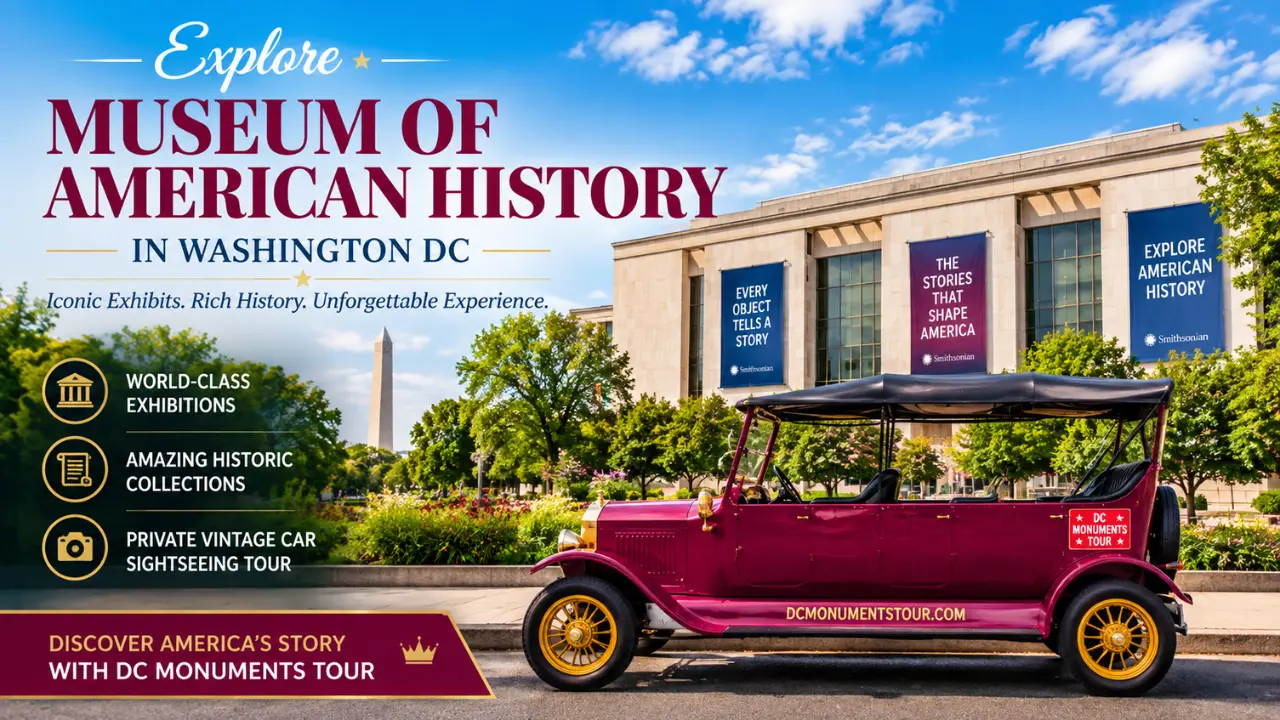
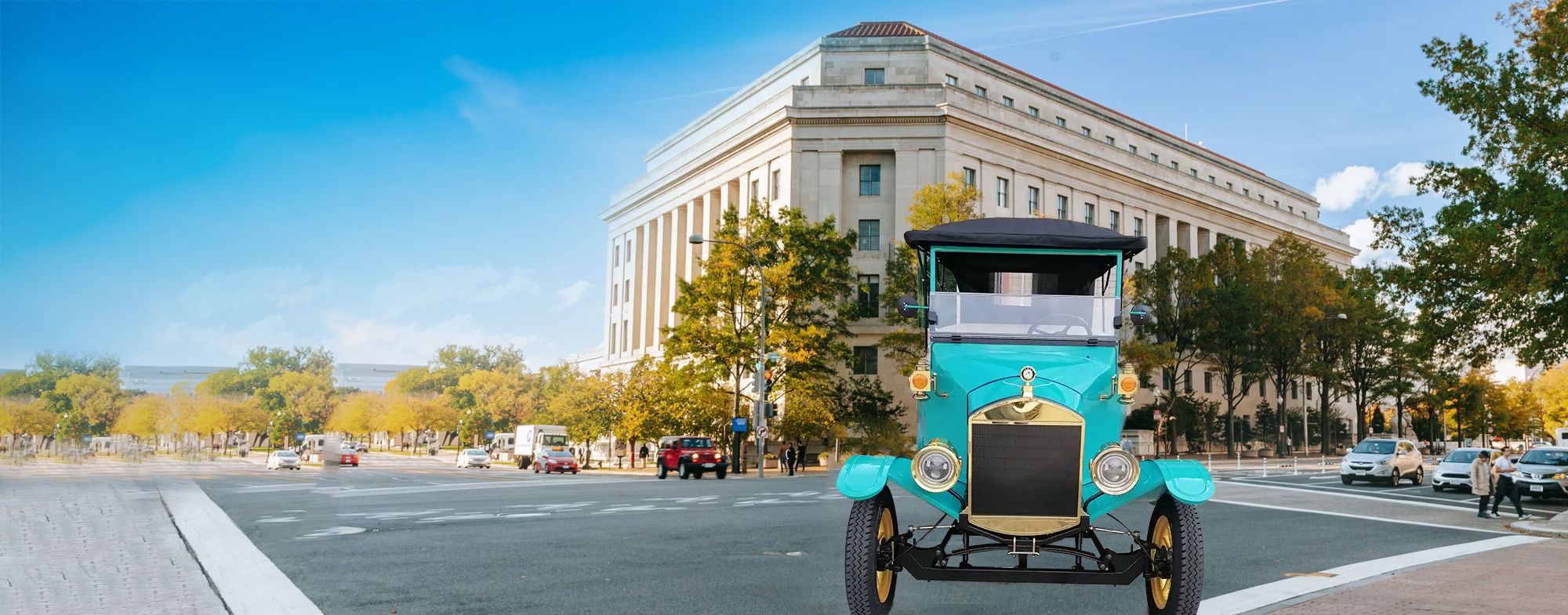
The vintage-style electric vehicles also provide an alternative to a conventional sightseeing bus and can make it easier to combine outdoor monument stops with museum visits during a single day.
Key Takeaways
- Start early with the National Archives for America's founding documents.
- Use the National Mall to connect several major chapters of American history.
- Prioritize the World War II, Vietnam, and Lincoln memorials for a strong historical sequence.
- Spend the afternoon at the National Museum of American History.
- Finish near the White House or continue with optional evening monument sightseeing.
- Check official attraction hours and entry requirements before your visit.
- Do not try to visit every museum in one day.
- Use private transportation strategically if you want to reduce unnecessary walking and backtracking.
Conclusion: Make Your One Day in Washington DC Count
A one-day Washington DC history itinerary does not need to feel rushed if you focus on the right locations.
Start with the original documents that established the United States. Continue through the National Mall and its memorials to explore war, leadership, sacrifice, civil rights, and national memory. Then spend the afternoon inside the National Museum of American History, where artifacts and exhibitions provide broader context.
The most important thing is to prioritize depth over quantity. Washington DC has enough history to fill several weeks, but with a logical route and realistic schedule, one day can still provide a meaningful introduction to the American story.