
Located between the Washington Monument and Lincoln Memorial, this site captures the unity of a nation during one of history’s toughest times. Get to know the stories of the 16 million Americans who fought and served for the nation with our guides.
The World War II Memorial is one of the most important memorials on the National Mall in Washington DC. Located between the Washington Monument and the Lincoln Memorial, it honors the 16 million Americans who served in the U.S. armed forces during World War II, the more than 400,000 who died, and the millions who supported the war effort from home.
Dedicated on May 29, 2004, the memorial combines granite architecture, bronze sculptures, fountains, inscriptions, and 56 pillars representing the states, territories, and District of Columbia at the time of World War II. Its large central pool and open design create a powerful setting for remembering the scale and sacrifice of the conflict.
Explore a private Washington DC tour with DC Monuments Tour to see the World War II Memorial alongside other major monuments and memorials with a local guide.
About the World War II Memorial
The World War II Memorial is located at the eastern end of the Lincoln Memorial Reflecting Pool, between the Washington Monument and Lincoln Memorial. Its position places it directly along one of the most visited sightseeing routes on the National Mall.
The memorial was designed by architect Friedrich St. Florian. Its architecture uses a large oval plaza, granite pillars, arches, fountains, bronze sculptures, and inscriptions to represent the scale of America's participation in World War II.
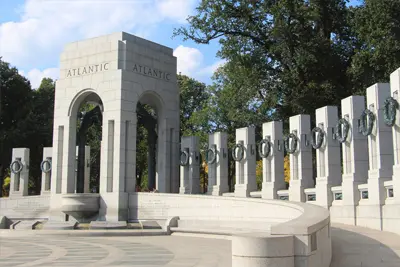
The 56 pillars surround the central Rainbow Pool and represent the 48 states that existed during the war, the District of Columbia, Alaska Territory, Hawaii Territory, and U.S. territories and possessions. The memorial also contains two large granite arches representing the Atlantic and Pacific theaters.
The design creates a balance between national unity and individual sacrifice. Visitors can walk around the memorial, read inscriptions, examine the sculptures, and reflect on the people represented by the memorial.
World War II Memorial Quick Facts
- Dedicated to: Americans who served and supported the United States during World War II
- Dedicated: May 29, 2004
- Architect: Friedrich St. Florian
- Location: National Mall, Washington DC
- Address: 1750 Independence Ave. SW, Washington, DC 20024
- Served in U.S. armed forces: Approximately 16 million Americans
- U.S. military deaths: More than 400,000
- State and territory pillars: 56
- Main features: Rainbow Pool, Atlantic and Pacific arches, Freedom Wall, bronze sculptures and inscriptions
- Entrance fee: Free
- Hours: Open 24 hours a day
- Accessibility: Wheelchair accessible
Why Is the World War II Memorial Important?
The World War II Memorial is important because it honors an entire generation affected by one of the largest conflicts in modern history.
World War II involved millions of Americans serving overseas as well as millions of civilians supporting the war effort at home. The memorial recognizes both groups rather than focusing only on military leaders or individual battles.
The memorial's design emphasizes unity. The 56 pillars surround the central pool and represent the states, territories, and District of Columbia that were part of the United States during the war.
The Freedom Wall provides another powerful reminder of the human cost of the conflict. Its 4,048 gold stars represent the approximately 400,000 Americans who died during World War II.
By combining architecture, water, sculpture, and inscriptions, the memorial encourages visitors to consider both the national effort and the individual sacrifices behind the war.
World War II Memorial Design & Architecture
The World War II Memorial was designed by architect Friedrich St. Florian. Its architecture is based on symmetry, open space, classical forms, and large granite elements.
The memorial is arranged around a central oval pool known as the Rainbow Pool. Granite pillars form a semicircle around the pool, while two monumental arches rise at opposite ends of the memorial.
The Atlantic Arch represents the European and Atlantic theater of the war, while the Pacific Arch represents the Pacific theater. Together, they frame the central space and help visitors understand the global nature of the conflict.
The 56 granite pillars are connected by bronze ropes, symbolizing the unity of the nation during wartime. Each pillar is associated with a state, territory, or the District of Columbia.
Bronze sculptures and reliefs throughout the memorial depict scenes connected with military service and the wartime experience. The combination of stone, bronze, water, and open space gives the memorial a formal but accessible character.
Explore the Main Features of the World War II Memorial
The 56 Pillars
The 56 pillars are among the most recognizable features of the World War II Memorial. They represent the states, territories, and District of Columbia that made up the United States during World War II.
The pillars surround the Rainbow Pool and are connected by bronze ropes. Together, they represent the unity of the American states and territories during the conflict.
Atlantic Arch
The Atlantic Arch stands at one end of the memorial and represents the Atlantic and European theater of World War II.
Its large scale creates a strong visual entrance to the memorial. The arch is decorated with inscriptions and architectural details that connect the structure with America's wartime experience.
Pacific Arch
The Pacific Arch stands opposite the Atlantic Arch and represents the Pacific theater of the war.
The two arches create a visual relationship across the central plaza. Together, they remind visitors that American forces fought on multiple fronts across the globe.
Rainbow Pool
The Rainbow Pool is the large central water feature of the memorial. The fountains and surrounding granite architecture create one of the most recognizable views of the site.
Water adds movement to the otherwise monumental stone landscape. The pool also creates reflections of the surrounding pillars and arches, making it an especially popular area for photography.
Freedom Wall
The Freedom Wall is one of the most meaningful features of the memorial. It contains 4,048 gold stars representing the more than 400,000 Americans who died during World War II.
The wall provides a quieter and more personal reminder of the human cost of the conflict. The large field of stars contrasts with the architectural scale of the surrounding memorial.
Bronze Sculptures
Bronze sculptures throughout the memorial depict different aspects of military service and wartime life.
These sculptures help connect the large architectural spaces with individual experiences. Rather than presenting World War II only through dates and statistics, the artwork gives visitors a more human perspective on the people who served.
What Do the Gold Stars at the World War II Memorial Mean?
The gold stars on the Freedom Wall represent the Americans who died during World War II.
There are 4,048 gold stars on the wall, symbolizing the more than 400,000 American military deaths during the war.
The stars are arranged across the wall behind the inscription "Here We Mark the Price of Freedom." The wall is one of the most reflective areas of the memorial and provides a place for visitors to pause and consider the scale of the loss.
What Do the 56 Pillars at the WWII Memorial Represent?
The 56 pillars represent the states, territories, and District of Columbia that made up the United States during World War II.
Each pillar carries the name of a state, territory, or district. The pillars are arranged around the Rainbow Pool and connected by bronze ropes.
The arrangement represents national unity during a period when Americans were mobilized for a common purpose. It also emphasizes that the war effort involved communities across the entire country.
World War II Memorial Inscriptions & Quotes
Inscriptions are an important part of the World War II Memorial. Words carved into the granite help explain the significance of the conflict and the sacrifices made by Americans.
The memorial includes references to wartime leadership, military service, national unity, sacrifice, and freedom.
One of the most recognizable inscriptions appears on the Freedom Wall, where the gold stars are accompanied by the words "Here We Mark the Price of Freedom."
Other inscriptions and quotations are incorporated into the architectural elements throughout the memorial. Reading these words while standing among the pillars and arches provides additional context for the monument.
Where Is the World War II Memorial?
The World War II Memorial is located on the National Mall in Washington DC, between the Washington Monument and Lincoln Memorial.
Address: 1750 Independence Ave. SW, Washington, DC 20024
The memorial's central location makes it easy to include in a larger National Mall sightseeing route. The Washington Monument is nearby, while the Lincoln Memorial is located to the west at the opposite end of the Reflecting Pool.
The memorial is also close to the Korean War Veterans Memorial and Vietnam Veterans Memorial, making it possible to visit several important American war memorials during the same outing.
For a broader overview of Washington DC's major landmarks, explore our guide to the best Washington DC monuments to visit in 2026.
World War II Memorial Hours & Admission
The World War II Memorial is open 24 hours a day, every day of the year. There is no entrance fee or pass required to visit the memorial.
National Park Service rangers are generally available during daytime and evening hours to answer questions and provide assistance. Ranger availability can vary, so visitors who want interpretive assistance should check current National Park Service information before visiting.
The memorial is outdoors, so weather can affect the visitor experience. Washington DC can become hot and humid during summer, while winter temperatures can be cold.
The memorial's fountains are turned off during the winter months, approximately from December through March. Visitors interested in seeing the fountains operating may want to plan their visit during the warmer months.
Is the World War II Memorial Accessible?
Yes. The World War II Memorial is wheelchair accessible and is designed to accommodate visitors with different mobility needs.
The National Park Service identifies the major monuments and memorials on the National Mall as wheelchair accessible. A limited number of loaner wheelchairs are also available at the World War II Memorial on a first-come, first-served basis.
Visitors who need accessibility assistance should check current National Park Service information before their visit, particularly if they require specific services or equipment.
Our Washington DC accessibility guide provides additional information about visiting National Mall attractions.
Best Time to Visit the World War II Memorial
Because the World War II Memorial is open 24 hours, visitors have considerable flexibility when planning their visit.
Early Morning
Early morning can be a good time to visit if you prefer a quieter atmosphere. The soft morning light can also create attractive reflections across the Rainbow Pool.
Afternoon
Afternoon visits work well when the memorial is included in a larger National Mall itinerary. You can combine it with the Washington Monument, Lincoln Memorial, Korean War Veterans Memorial, and Vietnam Veterans Memorial.
Sunset
Sunset provides changing light across the granite pillars, arches, and central pool. It can be an excellent time for photography and a more relaxed visit.
Night
The World War II Memorial is open 24 hours, making nighttime visits possible. The illuminated architecture and fountains can create a very different atmosphere from daytime sightseeing.
For more ideas about exploring Washington DC after dark, see our guide to Washington DC night tours and places to visit after dark.
How Long Does It Take to Visit the World War II Memorial?
Most visitors can see the main features of the World War II Memorial in approximately 20 to 45 minutes.
A shorter visit may be enough to walk around the central pool, see the arches and pillars, photograph the memorial, and visit the Freedom Wall.
If you want to read the inscriptions, examine the bronze sculptures, learn about the different features, and spend time reflecting at the Freedom Wall, allow around 45 minutes to an hour.
The memorial is also easy to include as one stop during a larger National Mall sightseeing tour.
Nearby Attractions to Combine With the World War II Memorial
The World War II Memorial has one of the most convenient locations on the National Mall. Several major monuments and memorials are within a relatively short sightseeing route.
Washington Monument
The Washington Monument stands immediately east of the World War II Memorial. Its location makes it an easy landmark to include before or after visiting the memorial.
Lincoln Memorial
The Lincoln Memorial is located at the western end of the Reflecting Pool. The walk between the World War II Memorial and Lincoln Memorial provides views across one of the most recognizable landscapes in Washington DC.
Read our Lincoln Memorial tour guide to learn more about its history and significance.
Korean War Veterans Memorial
The Korean War Veterans Memorial is located southwest of the Lincoln Memorial and features 19 stainless-steel soldier statues representing a patrol moving through the Korean War landscape.
Our Korean War Veterans Memorial tour guide provides more information about this nearby landmark.
Vietnam Veterans Memorial
The Vietnam Veterans Memorial is another major war memorial located near the Lincoln Memorial. Its black granite wall and names of American service members create a very different experience from the architecture of the World War II Memorial.
Learn more through our Vietnam Veterans Memorial tour guide.
Martin Luther King Jr. Memorial
The Martin Luther King Jr. Memorial is located near the Tidal Basin and can be included in a wider Washington DC sightseeing route.
You can learn more about this landmark through our Martin Luther King Jr. Memorial tour guide.
Franklin Delano Roosevelt Memorial
The Franklin Delano Roosevelt Memorial is also located near the Tidal Basin. Its outdoor rooms, sculptures, waterfalls, and inscriptions provide a different approach to memorial design.
Our Franklin Delano Roosevelt Memorial guide covers its history and major features.
Explore the World War II Memorial With DC Monuments Tour
The World War II Memorial is easier to appreciate when you understand the meaning behind its pillars, arches, sculptures, Freedom Wall, and central pool.
DC Monuments Tour includes the World War II Memorial among the major Washington DC landmarks featured in its sightseeing experiences. A local guide can help explain the memorial's history while you explore other important sites across the National Mall.
Our Washington DC Day Tour includes the World War II Memorial along with several other major landmarks and memorials.
For visitors who prefer a more personalized experience, our Private Washington DC Tours provide a flexible way to explore the city's monuments and memorials.
You can also explore Washington DC after dark with our Washington DC Night Tour.
Why Visit the World War II Memorial?
The World War II Memorial is worth visiting because it combines large-scale architecture with a deeply personal reminder of wartime sacrifice.
- Honor 16 million Americans: The memorial recognizes the Americans who served in the armed forces during World War II.
- See the 56 pillars: Walk around the pillars representing the states, territories, and District of Columbia.
- Visit the Freedom Wall: See the 4,048 gold stars representing the more than 400,000 Americans who died during the war.
- Explore the Atlantic and Pacific arches: Understand how the memorial represents the two major theaters of the conflict.
- See the Rainbow Pool: Experience one of the memorial's most recognizable architectural and water features.
- Read the inscriptions: Explore words and historical references incorporated throughout the memorial.
- Visit day or night: The memorial is open 24 hours a day.
- Combine nearby landmarks: Include the Washington Monument, Lincoln Memorial, Korean War Veterans Memorial, Vietnam Veterans Memorial, and other National Mall attractions in the same sightseeing route.
Book Your Washington DC Monuments Tour
The World War II Memorial is more than an impressive collection of granite pillars and arches. It is a national tribute to the millions of Americans who served, supported the war effort, and sacrificed their lives during World War II.
From the Atlantic and Pacific arches to the 56 pillars, Rainbow Pool, bronze sculptures, inscriptions, and Freedom Wall, each part of the memorial contributes to the larger story of service, unity, sacrifice, and freedom.
Explore the World War II Memorial and other iconic landmarks with DC Monuments Tour.
Choose from our Washington DC sightseeing tours and experience the history of the nation's capital with a knowledgeable local guide.