
The Smithsonian Air & Space Museum Tour Washington DC is an excellent choice for travelers interested in aviation, space exploration, science, and American history. Located on the National Mall at 650 Jefferson Drive SW, the National Air and Space Museum houses historic aircraft, spacecraft, rockets, spacesuits, and other artifacts connected to the history of flight. Admission is free, but free timed-entry passes are currently required for all visitors. The museum is open daily from 10:00 a.m. to 5:30 p.m., except December 25. Major highlights include the 1903 Wright Flyer, Apollo 11 Command Module Columbia, Neil Armstrong's Apollo 11 spacesuit, and other landmark objects. Visitors can also combine their museum visit with nearby attractions such as the National Mall, U.S. Capitol, National Museum of the American Indian, Washington Monument, and Smithsonian museums.
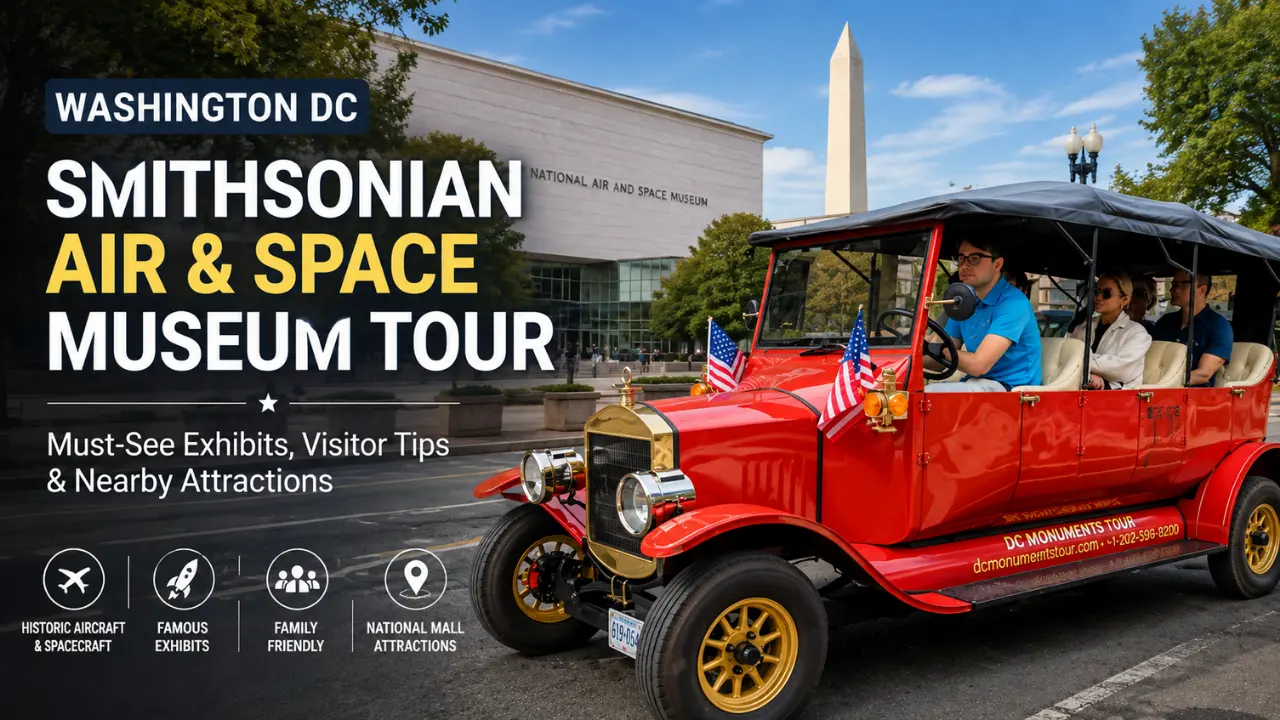
Table of Contents
- Introduction
- Why Visit the Smithsonian Air & Space Museum in Washington DC?
- Smithsonian Air & Space Museum Visitor Information
- Must-See Exhibits and Artifacts
- Smithsonian Air & Space Museum Tour Options
- Air & Space Museum and Electric Cart Sightseeing
- Nearby Attractions
- Suggested Air & Space Museum Tour Itinerary
- Best Time to Visit
- Tips for Families and First-Time Visitors
- Photography and Sightseeing Tips
- How Much Walking Is Involved?
- Common Mistakes to Avoid
- Why Add the Air & Space Museum to a DC Sightseeing Tour?
- Plan Your Washington DC Sightseeing Tour
- Final Thoughts
- Frequently Asked Questions
Introduction
Washington DC is famous for its monuments, memorials, government buildings, and Smithsonian museums. Among these attractions, the Smithsonian National Air and Space Museum stands out for its connection to aviation, space exploration, scientific discovery, and technological innovation.
Located along the National Mall, the museum gives visitors an opportunity to see historic aircraft, spacecraft, scientific instruments, and other objects associated with some of the most important milestones in aviation and space history.
For travelers planning a Smithsonian Air & Space Museum Tour Washington DC, the museum can easily become part of a larger sightseeing itinerary. Its location places it close to the U.S. Capitol, National Museum of the American Indian, National Gallery of Art, Washington Monument, and several other major attractions.
A well-planned visit allows you to explore the museum while also experiencing the wider National Mall without trying to cover too much in a single day.
Why Visit the Smithsonian Air and Space Museum in Washington DC?
The National Air and Space Museum is part of the Smithsonian Institution and preserves one of the world's most significant collections related to aviation and space exploration.
Its exhibits help visitors understand how aviation developed from early experiments in flight into modern aircraft and how space exploration progressed from early rocketry to crewed lunar missions and beyond.
One of the museum's biggest attractions is its collection of historic artifacts. Visitors can see aircraft and spacecraft associated with major moments in aviation history, including the 1903 Wright Flyer and Apollo 11 Command Module Columbia.
The museum is also appealing because it combines historical artifacts with scientific explanations and interactive experiences. This makes it suitable for families, students, aviation enthusiasts, history travelers, and first-time visitors to Washington DC.
General admission is free, although visitors should check the museum's current timed-entry requirements before planning their visit.
Smithsonian Air and Space Museum Visitor Information
| Information | Details |
|---|---|
| Museum | Smithsonian National Air and Space Museum |
| Location | National Mall, Washington DC |
| Admission | Free general admission |
| Entry | Timed-entry passes may be required |
| Collection | Aircraft, spacecraft, aviation artifacts, scientific objects, and related exhibits |
| Best For | Families, aviation enthusiasts, space enthusiasts, students, history lovers, and first-time visitors |
| Location Advantage | Close to major National Mall museums, monuments, and landmarks |
Visitor information, exhibit availability, hours, entry requirements, and temporary closures can change. Check the official Smithsonian National Air and Space Museum website before your visit for the latest information.
Quick Facts About the Air and Space Museum
| Category | Details |
|---|---|
| Type | Smithsonian aviation and space museum |
| Location | National Mall, Washington DC |
| Admission | Free |
| Main Themes | Aviation, space exploration, science, technology, and innovation |
| Historic Artifacts | Wright Flyer, Apollo spacecraft, aircraft, spacecraft, and other aviation objects |
| Family Friendly | Yes |
| Accessibility | Accessibility services and resources are available |
| Nearby Attractions | U.S. Capitol, National Mall, National Gallery of Art, Washington Monument, and other Smithsonian museums |
Must-See Exhibits and Artifacts
The museum's collection is extensive, so first-time visitors should identify a few priority exhibits before arriving.
Trying to explore every gallery can take considerably longer than expected. Instead, choose the subjects that interest you most and build the rest of your visit around them.
1903 Wright Flyer
The 1903 Wright Flyer is one of the museum's most historically significant objects.
The aircraft represents the Wright brothers' pioneering work in powered flight and is displayed as an important symbol of the development of aviation.
For visitors interested in the history of flight, this is one of the artifacts worth prioritizing during a first visit.
Apollo 11 Command Module Columbia
The Apollo 11 Command Module Columbia is another major highlight.
Columbia carried astronauts during the historic Apollo 11 mission, the first crewed mission to land humans on the Moon.
Seeing the spacecraft in person provides a tangible connection to one of the most significant achievements in space exploration.
Space Exploration Exhibits
The museum covers numerous chapters in the history of space exploration.
Depending on current exhibitions and gallery availability, visitors can learn about early space programs, human spaceflight, planetary exploration, rockets, spacecraft, and the scientific challenges involved in exploring beyond Earth.
Space-related exhibits can be particularly engaging for children and visitors who have an interest in astronomy and engineering.
Aviation Exhibits
The museum's aviation collection extends far beyond the Wright Flyer.
Visitors can explore objects representing different stages of aviation development, including early aircraft, military aviation, commercial flight, and technological advances that transformed how people travel.
These exhibits help demonstrate how aircraft design, propulsion, navigation, and flight technology evolved over time.
Planetary and Science Exhibits
The museum also connects aviation and space exploration with broader scientific subjects.
Visitors can explore exhibits that explain planetary science, astronomy, atmospheric science, and the technologies used to study Earth and the universe.
These areas can add scientific context to the historic aircraft and spacecraft displayed throughout the museum.
You May Also Like: Smithsonian Castle Tour in Washington DC: Explore DC’s Iconic Red-Sandstone Landmark
Tour Options at the Air and Space Museum
There are several ways to experience the Smithsonian Air and Space Museum depending on your interests, available time, and preferred sightseeing style.
| Tour Option | Best For |
|---|---|
| Self-Guided Visit | Visitors who want to explore exhibits independently |
| Exhibition-Focused Visit | Travelers who want to prioritize aviation or space exhibits |
| Family Visit | Families looking for interactive and educational experiences |
| Smithsonian Visit Combined With Sightseeing | Travelers who want to explore the museum and National Mall landmarks on the same day |
| Private DC Sightseeing Tour | Visitors who want comfortable transportation between major Washington DC attractions |
The museum itself provides visitor resources and educational programming. Availability can vary, so check the current Smithsonian schedule before your visit.
Smithsonian Air and Space Museum and Electric Cart Sightseeing
A museum visit can be combined with a broader Washington DC sightseeing experience.
The National Air and Space Museum sits in an area where several major attractions are located within the wider National Mall district. This makes it practical to combine an interior museum visit with sightseeing around Washington DC.
For visitors who want to see multiple landmarks without walking the entire National Mall, an electric cart sightseeing tour can provide a comfortable way to travel between selected locations.
DC Monuments Tour offers private Washington DC sightseeing experiences by electric cart, allowing visitors to explore major landmarks with a guide while reducing the amount of walking between stops.
The sightseeing experience can complement a museum visit by covering nearby landmarks such as the U.S. Capitol, Washington Monument, Lincoln Memorial, Jefferson Memorial, White House, and other major DC attractions.
It is important to understand that a sightseeing tour and museum admission are separate experiences. A cart tour may provide views or stops around the museum, while visitors who want to explore the interior should plan dedicated museum time.
If aviation and space exhibits are your main priority, reserve enough time for the museum itself. If your goal is to see as many Washington DC landmarks as possible, combine your museum visit with a sightseeing tour around the National Mall.
You May Also Like: National Gallery of Art Washington DC Tour: Highlights, Tips & Nearby Attractions
Nearby Attractions
The National Air and Space Museum's location makes it convenient to combine with several major Washington DC attractions.
1. U.S. Capitol
The U.S. Capitol is one of the most recognizable landmarks in Washington DC and sits near the eastern end of the National Mall.
Its iconic dome, surrounding grounds, and Capitol Hill setting make it an important stop for first-time visitors.
2. National Mall
The National Mall is the central sightseeing corridor connecting many of Washington DC's major museums, monuments, and memorials.
The Air and Space Museum's location makes it easy to include in a larger National Mall itinerary.
3. National Gallery of Art
Art enthusiasts can combine their Air and Space Museum visit with the National Gallery of Art.
The Gallery offers extensive collections of European and American art and is located close to the eastern section of the National Mall.
4. National Museum of the American Indian
The National Museum of the American Indian is another Smithsonian museum located near the Air and Space Museum.
Its exhibitions focus on the histories, cultures, and artistic traditions of Native peoples of the Americas.
5. Washington Monument
The Washington Monument is one of the most recognizable landmarks in the capital.
Its location makes it a natural addition to a National Mall sightseeing route after visiting the museum.
6. National Museum of Natural History
Families and science enthusiasts can also consider the National Museum of Natural History.
The museum offers a completely different experience, focusing on natural science, biodiversity, geology, fossils, and human origins.
7. National Museum of African American History and Culture
The National Museum of African American History and Culture offers important historical and cultural exhibitions.
Its distinctive architecture and location along the National Mall also make it a notable stop during a Washington DC sightseeing day.
Suggested Air and Space Museum Tour Itinerary
A practical itinerary should allow enough time for the museum without trying to visit too many major attractions at once.
| Approximate Time | Suggested Activity |
|---|---|
| 9:30 AM | Arrive near the National Mall and prepare for your museum visit. |
| 10:00 AM | Enter the Smithsonian National Air and Space Museum. |
| 10:00 AM–12:30 PM | Explore priority aviation, space, and historic artifact exhibits. |
| 12:30 PM | Take a lunch or refreshment break. |
| 1:30 PM | Continue exploring selected galleries or complete any exhibits missed earlier. |
| 3:00 PM | Begin National Mall sightseeing. |
| 3:30 PM onward | Visit nearby landmarks or continue with a guided Washington DC sightseeing tour. |
This is a sample itinerary rather than an official Smithsonian schedule. Actual opening times, timed-entry requirements, exhibits, and programs should be checked before your visit.
Best Time to Visit
The best time to visit depends on your sightseeing priorities.
Morning can be a practical option for travelers who want to explore the museum before visiting outdoor landmarks later in the day.
Weekdays may also appeal to visitors who prefer a potentially quieter sightseeing experience, although visitor numbers vary depending on season, holidays, school breaks, and special events.
If you plan to combine the museum with outdoor monuments, consider Washington DC's weather. Summer can be hot and humid, while winter temperatures may make extended outdoor sightseeing less comfortable.
Another important consideration is your overall itinerary. Visiting a large museum and several monuments on the same day can involve more walking and travel time than expected.
Tips for Families and First-Time Visitors
The Air and Space Museum is especially popular with families, but planning ahead can make the experience more enjoyable.
- Check entry requirements: Confirm whether timed-entry passes are required for your selected date.
- Choose priority exhibits: Decide which aircraft, spacecraft, or galleries your family most wants to see.
- Allow enough time: Avoid rushing through major exhibits simply to reach the next attraction.
- Take breaks: Museum visits can become tiring, especially for younger children.
- Plan nearby attractions carefully: Choose a manageable number of additional landmarks.
- Check accessibility: Review current accessibility information if your group requires specific accommodations.
- Use public transportation or sightseeing transportation: This can reduce the stress of navigating and parking in central Washington DC.
- Check the official museum information: Exhibitions, hours, and visitor policies can change.
You May Also Like: National Museum of African American History & Culture Tour Washington DC: Exhibits, Stories & Visitor Guide
Photography and Sightseeing Tips
The Air and Space Museum contains many visually interesting aircraft, spacecraft, and historic objects.
Photography policies can vary by gallery or special exhibition, so visitors should follow posted rules and staff instructions.
When planning photographs outside the museum, the surrounding National Mall provides additional opportunities to capture Washington DC landmarks.
If you are traveling with a camera or smartphone, consider leaving enough time between indoor and outdoor attractions rather than rushing from one location to another.
How Much Walking Is Involved?
A museum visit can involve considerable walking because visitors typically move through multiple galleries and exhibition spaces.
The amount of walking increases when you combine the museum with several National Mall attractions.
For example, visiting the Air and Space Museum, Washington Monument, Lincoln Memorial, and U.S. Capitol on foot can create a long sightseeing day.
An electric cart sightseeing tour can help reduce the amount of walking between selected landmarks. Instead of walking the entire distance between attractions, visitors can travel comfortably while a guide provides information about the city's history and landmarks.
However, an electric cart tour does not eliminate walking completely. Visitors still need to walk through museums, monuments, sidewalks, and individual attraction areas.
Common Mistakes to Avoid
- Arriving without checking current timed-entry requirements.
- Trying to see every museum on the National Mall in one day.
- Underestimating the amount of walking involved.
- Not checking current museum hours before visiting.
- Planning too many attractions immediately after a long museum visit.
- Assuming a sightseeing tour includes admission to museum interiors.
- Failing to identify must-see exhibits in advance.
- Not allowing time for meals and breaks.
- Ignoring Washington DC weather when planning outdoor sightseeing.
- Not checking accessibility information when traveling with someone who requires accommodations.
Why Add the Air and Space Museum to a DC Sightseeing Tour?
The Smithsonian Air and Space Museum adds a scientific and technological dimension to a Washington DC itinerary that may otherwise focus primarily on monuments, memorials, and government buildings.
Its collection connects visitors with important moments in aviation and space exploration, from the earliest powered flights to historic space missions.
The museum's location is another major advantage. Visitors can combine their museum experience with the National Mall, U.S. Capitol, National Gallery of Art, National Museum of the American Indian, Washington Monument, and other attractions.
For travelers with limited time, combining a dedicated museum visit with a private sightseeing tour can also make it easier to experience more of Washington DC without walking between every landmark.
Why Include the Air and Space Museum in Your DC Itinerary?
- Free general admission
- Historic aviation and space artifacts
- Famous objects such as the Wright Flyer and Apollo 11 Command Module
- Educational exhibits for visitors of different ages
- Excellent choice for families and science enthusiasts
- Convenient National Mall location
- Easy to combine with nearby museums and landmarks
- Suitable for first-time Washington DC visitors
- Can be combined with a broader private sightseeing experience
Plan Your Washington DC Sightseeing Tour
A successful Washington DC sightseeing day is usually about choosing attractions that work well together rather than attempting to see everything.
If aviation and space are high on your list, dedicate several hours to the National Air and Space Museum and prioritize the exhibits you most want to experience.
After the museum, you can continue toward nearby National Mall landmarks or choose a private sightseeing experience to cover more of Washington DC comfortably.
DC Monuments Tour offers private electric cart sightseeing experiences designed to help visitors explore major Washington DC landmarks with a guide.
A sightseeing route can complement your museum visit by allowing you to see additional attractions without spending the entire day walking between them.
Plan your Smithsonian Air & Space Museum Tour Washington DC as part of a broader sightseeing itinerary and make the most of your time in the nation's capital.
Final Thoughts
The Smithsonian Air & Space Museum Tour Washington DC offers an opportunity to explore some of the most important achievements in aviation, aerospace engineering, and space exploration.
From the historic Wright Flyer to the Apollo 11 Command Module, the museum connects visitors with milestones that changed how humans travel through the air and explore beyond Earth.
Its location on the National Mall makes the museum particularly convenient for travelers who want to combine science and history with Washington DC's famous monuments and landmarks.
For families, first-time visitors, aviation enthusiasts, and space enthusiasts, the museum can be one of the most memorable stops in the capital.
The key is to plan realistically. Choose your must-see exhibits, allow sufficient time inside the museum, and then explore nearby attractions at a comfortable pace.
If you want to cover more of Washington DC while reducing the amount of walking between landmarks, an electric cart sightseeing tour can complement your museum visit and provide a convenient way to experience the wider city.
You May Also Like: Museum of American History Tour Washington DC: Must-See Exhibits, History & Private Sightseeing Guide