
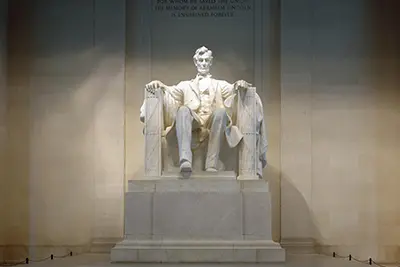
Experience the enduring legacy of Abraham Lincoln, whose vision of unity helped the nation heal. Sit on the steps where history has unfolded and feel the power of his words whilst looking at his thoughtful gaze. Our guides will help you understand how one man's vision of unity changed America forever.
The Lincoln Memorial is one of the most iconic landmarks in Washington, DC and a powerful tribute to Abraham Lincoln, the 16th President of the United States. Located at the western end of the National Mall, the memorial is known for its grand Greek-inspired architecture, massive columns, marble steps and the famous seated statue of Lincoln.
Inside the memorial chamber, visitors can see the 19-foot seated statue of Abraham Lincoln and read passages from two of his most important speeches: the Gettysburg Address and the Second Inaugural Address.
The memorial also occupies an important place in American civil rights history. Its steps became the setting for major events, including the 1963 March on Washington, where Dr. Martin Luther King Jr. delivered his famous I Have a Dream speech.
For visitors who want to explore the Lincoln Memorial along with the other major landmarks of the National Mall, a private Washington DC tour offers a comfortable way to experience the area with a local guide.
About the Lincoln Memorial
The Lincoln Memorial was created to honor Abraham Lincoln and his leadership during the Civil War. Lincoln worked to preserve the Union and issued the Emancipation Proclamation, which helped move the country toward the abolition of slavery.
Congress authorized the memorial in 1911, and construction began in 1914. Architect Henry Bacon designed the building, drawing inspiration from the classical Greek temple tradition. The memorial was dedicated on May 30, 1922.
The location at the western end of the National Mall was carefully chosen. The memorial faces east toward the Washington Monument and the U.S. Capitol, creating one of the most recognizable visual axes in Washington, DC.
Lincoln Memorial Quick Facts
- Location: Western end of the National Mall, Washington, DC
- Honors: Abraham Lincoln, 16th President of the United States
- Architect: Henry Bacon
- Dedicated: May 30, 1922
- Architectural style: Greek-inspired neoclassical design
- Columns: 36 Doric columns
- Statue: 19-foot seated statue of Abraham Lincoln
- Sculptor: Daniel Chester French
- Speeches displayed: Gettysburg Address and Second Inaugural Address
- Admission: Free
- Public hours: Open 24 hours a day
Why Is the Lincoln Memorial Important?
The Lincoln Memorial represents more than the life of one president. It has become a national symbol associated with freedom, unity, equality and the continuing effort to uphold democratic ideals.
Lincoln led the United States through the Civil War, the nation's most devastating internal conflict. His leadership focused on preserving the Union, while his Emancipation Proclamation changed the role of the war in relation to slavery.
The memorial's later role in the civil rights movement added another important chapter to its history. Its steps became a gathering place for people advocating for racial equality and civil rights.
This combination of presidential history, architecture and civil rights history makes the Lincoln Memorial one of the most significant places to visit on the National Mall.
Lincoln Memorial Architecture
The Lincoln Memorial was designed in the style of a Greek Doric temple. Henry Bacon used classical architecture to connect Lincoln's legacy with the democratic traditions associated with ancient Greece.
The building is surrounded by 36 fluted Doric columns. Each column represents one of the states in the Union at the time of Lincoln's death in 1865. The columns are approximately 44 feet tall.
The memorial uses several types of stone from different parts of the United States, including Colorado Yule marble, Indiana limestone and Georgia marble for the Lincoln statue. The use of materials from different states also contributes to the memorial's national character.
The 36 Columns
The 36 columns surrounding the memorial are among its most recognizable architectural features.
The number 36 has a specific historical meaning. It represents the 36 states that formed the Union when Abraham Lincoln died in 1865.
The names of those states are carved into the frieze above the columns. Later, the names of the 48 states in the Union when the memorial was completed were added to the exterior attic walls. A plaque in the plaza recognizes the later admission of Alaska and Hawaii.
The Statue of Abraham Lincoln
At the center of the memorial chamber sits the famous 19-foot statue of Abraham Lincoln.
The statue was designed by sculptor Daniel Chester French and carved by the Piccirilli Brothers. It was made from 28 blocks of Georgia marble and depicts Lincoln seated in a thoughtful, commanding pose.
Lincoln's posture is one of the statue's most recognizable features. One hand is tightly clenched while the other is more relaxed, creating a visual contrast that has often been interpreted as representing strength and compassion.
The statue sits between the two chambers containing inscriptions of Lincoln's major speeches. This placement makes the statue, his words and the architectural space work together as one memorial experience.
The Gettysburg Address
The Gettysburg Address is carved into the south chamber of the Lincoln Memorial.
Lincoln delivered the address on November 19, 1863, during the dedication of the Soldiers' National Cemetery at Gettysburg, Pennsylvania. The short speech focused on the meaning of the Civil War and the principles of equality and democratic government.
Seeing the Gettysburg Address carved into the marble wall gives visitors an opportunity to experience one of Lincoln's most important speeches in the setting of a national memorial.
The Second Inaugural Address
Lincoln's Second Inaugural Address is carved into the north chamber of the memorial.
Lincoln delivered the speech on March 4, 1865, near the end of the Civil War. The address reflected on the conflict, slavery and the difficult process of national reconciliation.
The speech is displayed opposite the Gettysburg Address, allowing visitors to compare two important moments in Lincoln's presidency and his understanding of the nation's future.
The Lincoln Memorial Murals
Large murals appear above the inscriptions of Lincoln's speeches. Artist Jules Guerin created the two murals, which represent ideas associated with Lincoln's life and presidency.
The mural above the Gettysburg Address represents themes including freedom, liberty, justice and the law. The mural above the Second Inaugural Address emphasizes unity, fraternity and charity.
The murals add color and symbolism to an interior that is otherwise dominated by white and gray marble.
The Lincoln Memorial Steps
The broad steps leading to the memorial are one of the most recognizable public spaces in Washington, DC.
From the top of the steps, visitors can look east across the Reflecting Pool toward the Washington Monument. This view is one of the classic Washington DC sightseeing photographs.
The steps also have major historical significance. They hosted Marian Anderson's famous 1939 concert and became the setting for Dr. Martin Luther King Jr.'s 1963 I Have a Dream speech during the March on Washington.
Lincoln Memorial and the March on Washington
On August 28, 1963, hundreds of thousands of people gathered in Washington, DC during the March on Washington for Jobs and Freedom.
Dr. Martin Luther King Jr. delivered his famous I Have a Dream speech from the steps of the Lincoln Memorial. The location connected the civil rights movement with Lincoln's legacy and the ideals associated with emancipation and equality.
Today, visitors can stand on the same steps and look across the Reflecting Pool toward the Washington Monument, making the location an important part of both presidential and civil rights history.
You can learn more about the nearby memorial dedicated to Dr. King on our Martin Luther King Jr. Memorial page.
Lincoln Memorial and the Reflecting Pool
The Lincoln Memorial Reflecting Pool extends east from the memorial toward the Washington Monument. Its long, symmetrical shape creates a strong visual connection between two of Washington's most recognizable landmarks.
The pool is especially popular for photography because the Washington Monument can be reflected in its water on clear days.
The surrounding National Mall also connects the Lincoln Memorial with the World War II Memorial, Vietnam Veterans Memorial and other major attractions.
Lincoln Memorial Location
The Lincoln Memorial is located at the western end of the National Mall in Washington, DC.
Address: 2 Lincoln Memorial Circle NW, Washington, DC 20002
The memorial is positioned directly at the western end of the Reflecting Pool. Its location makes it easy to combine with several major memorials and attractions during the same sightseeing trip.
Lincoln Memorial Hours and Admission
The Lincoln Memorial is open 24 hours a day and admission is free. No entrance ticket or pass is required for the main memorial.
Although the memorial grounds remain open around the clock, visitor facilities such as restrooms, museums and elevators close in the evening.
This makes the Lincoln Memorial a flexible stop for both daytime sightseeing and nighttime monument tours.
Is the Lincoln Memorial Accessible?
Yes. The National Park Service welcomes visitors with disabilities and provides accessible routes to the memorial chamber.
An elevator provides access to the chamber where visitors can see the Lincoln statue and inscriptions. The undercroft experience is also accessible and includes tactile exhibits and other interpretive features.
The site also provides accessible restrooms, tactile models, braille materials, audio descriptions and open captions for the undercroft film. ASL interpretation is available upon request with advance arrangements.
Visitors planning to explore several National Mall attractions can also read our Washington DC accessibility guide.
The Lincoln Memorial Undercroft
The Lincoln Memorial also includes an undercroft experience beneath the main structure. This space provides exhibits about the construction of the memorial and its role in American history and the civil rights movement.
Timed-entry tickets are required for the undercroft experience, and visitors must pass through security screening before entering.
The undercroft includes interactive and multimedia exhibits, tactile models and accessible interpretive features. It offers a different way to understand how the memorial was designed and how its meaning developed over time.
Best Time to Visit the Lincoln Memorial
Early Morning
Early morning can be a good choice if you want a quieter experience and fewer people on the steps. The softer light can also be useful for photography.
Afternoon
Afternoon works well when the Lincoln Memorial is part of a larger National Mall itinerary. You can visit the nearby Vietnam Veterans Memorial, Korean War Veterans Memorial and World War II Memorial before or after seeing Lincoln.
Sunset
Sunset offers views across the Reflecting Pool toward the Washington Monument as the light changes. It is one of the most scenic times to photograph the memorial and National Mall.
Night
The Lincoln Memorial is open 24 hours, and the illuminated building creates a different atmosphere after dark. The steps and columns are especially striking at night.
For more ideas about visiting Washington's monuments after sunset, see our guide to Washington DC night tours and places to visit at night.
How Long Does It Take to Visit the Lincoln Memorial?
A basic visit to the Lincoln Memorial can take around 30 to 60 minutes. This gives you enough time to climb or access the memorial, view the statue, read the inscriptions and spend time on the steps.
If you want to explore the undercroft, read the historical displays or combine the memorial with nearby attractions, allow additional time.
The Lincoln Memorial is also an ideal starting or ending point for a broader National Mall itinerary because several major monuments are within a relatively short distance.
Nearby Attractions to Visit
The Lincoln Memorial sits close to several of Washington, DC's most important monuments and memorials.
- Vietnam Veterans Memorial – A powerful memorial featuring the names of more than 58,000 service members.
- Korean War Veterans Memorial – A memorial honoring those who served in the Korean War.
- World War II Memorial – A major memorial between the Lincoln Memorial and Washington Monument.
- Washington Monument – The famous obelisk standing at the opposite end of the Reflecting Pool.
- Franklin Delano Roosevelt Memorial – An outdoor memorial along the Tidal Basin.
- Martin Luther King Jr. Memorial – A nearby memorial honoring the civil rights leader.
Explore the Lincoln Memorial with DC Monuments Tour
The Lincoln Memorial is one of the must-see landmarks on the National Mall, but visiting several nearby monuments can involve a significant amount of walking.
With private Washington DC tours, you can explore the National Mall without joining a shared group. Our vintage electric golf carts provide a convenient way to travel between major attractions while reducing the amount of walking required.
A private tour also gives families, couples and small groups more flexibility to spend time at the monuments that matter most to them.
If you want to see the major landmarks during the day, explore our Washington DC day tour.
For an illuminated sightseeing experience, consider our Washington DC night tour.
Why Visit the Lincoln Memorial?
- See the iconic 19-foot seated statue of Abraham Lincoln.
- Read the Gettysburg Address and Second Inaugural Address carved into the memorial walls.
- Admire the 36 Doric columns representing the Union states at Lincoln's death.
- Experience one of Washington DC's most important symbols of unity and equality.
- Stand on the historic steps where Dr. Martin Luther King Jr. delivered his 1963 speech.
- Enjoy views across the Reflecting Pool toward the Washington Monument.
- Explore the memorial during the day or after dark.
- Combine the visit with nearby Vietnam, Korean War and World War II memorials.
Plan Your Lincoln Memorial Visit
The Lincoln Memorial brings together American history, classical architecture and some of the most important moments in the country's civil rights story.
From the 19-foot statue of Abraham Lincoln to the words of the Gettysburg Address and Second Inaugural Address, every major feature of the memorial connects visitors with Lincoln's leadership and legacy.
The memorial's location also makes it an excellent starting point for exploring the National Mall. You can combine it with nearby war memorials, the Washington Monument and other major attractions during the same sightseeing trip.
Make your National Mall visit easier with a private Washington DC tour and explore the Lincoln Memorial alongside the city's other iconic landmarks.
Ready to explore Washington, DC? View our Washington DC tours and plan your sightseeing experience.